
Ant control in homes and gardens
Effective ant control targets the queen inside the nest, not the line you see on your kitchen table. At Sky Star Environmental Services, we identify the ant species and their movement patterns, then place food baits that the worker ants carry back to the colony. Random spraying kills what you see but leaves the queen to continue laying eggs in her hiding place. We treat black ants, sugar ants, and small Pharaoh ants inside homes, as well as ants in gardens and on sidewalks. The service includes a 30-day guarantee, and prices start from 150 SAR for apartments.
Signs of an ant colony
Seeing one or two ants is normal. However, these signs indicate a nearby colony:
- Regular lines of ants repeat in the same path every day.
- Very small yellow or light brown ants around sinks, electrical outlets, and bathrooms.
- Piles of fine soil between the patio tiles or at the edges of the sidewalk.
- Ants inside sugar and honey containers despite them being closed.
- Winged ants emerging from a crack in the wall or floor indicate a mature colony.
- Painful stings or bites when working in the garden.
Common types of ants found in homes
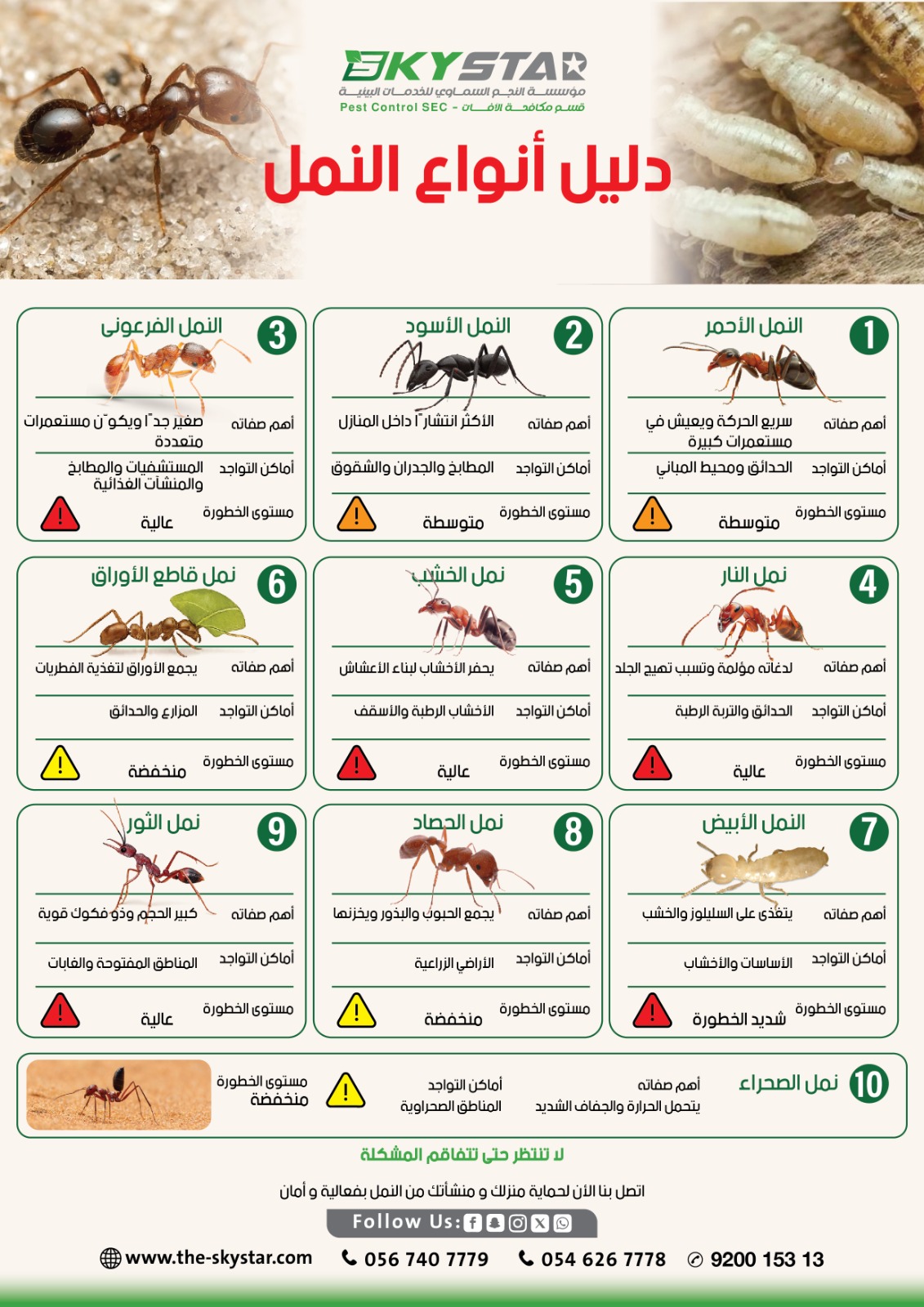
Black ants: medium in size, they often build their nests in the soil, gardens and under tiles, and enter the house in search of food through doors and cracks.
Sugar ants: small, attracted to sweets, juices, and leftover drinks. They suddenly appear in large numbers on tables and around the refrigerator.
Pharaoh ants: very small and yellowish in color. They nest inside walls, behind tiles, and in appliances, and are common in large buildings. Their colonies have multiple queens, and if disturbed by spraying, they divide into new colonies.
Fire ants in gardens: This name refers to a type of stinging ant found in gardens and lawns. Their sting is painful and can cause allergic reactions in some people, so we treat their nests with caution.
The difference between ants and termites
Termites are not ants, but a different insect that feeds on wood and cellulosic materials, causing structural damage. Ordinary ants, winged or not, have a slender waist and elbow-curved antennae, while winged termites have a continuous body and symmetrical wings. If you see mud tunnels on walls or hollow wood, contact a termite control service.
Why are ants so abundant in the cities of the Hijaz?
- Prolonged heat: Ants thrive in warmth, and long summers extend their season of activity and reproduction.
- Searching for water: In the hot months, ants enter houses towards sinks, air conditioners, and leaks.
- Irrigated gardens and planting beds in villas make moist soil an ideal nesting location.
- Jeddah's winter rains flood the nests in the soil, forcing the ants inside.
- Large buildings and complexes facilitate the spread of Pharaoh ants through extensions and spaces between apartments.
Damage and Risks
Most house ants are more of a nuisance than a threat, but they do cause real harm:
- Food contamination: Ants walk on surfaces and waste, then on food.
- Pharaoh ants in healthcare facilities: It is noted that they may transmit microbes between places, so hospitals and commercial kitchens pay special attention to them.
- Stings: Some garden ants deliver a painful sting, which may cause an allergic reaction in some people. If severe allergic symptoms occur, seek emergency medical attention.
- Electrical appliances: Ants may nest inside electrical outlets and panels.
Our step-by-step method
Why does spraying disperse the colony?
Direct spraying kills the ants you see, which is a small part of the colony. The queen remains in the nest and continues laying eggs. With species like Pharaoh ants, the disturbance of spraying causes the colony to split and move to multiple locations, making the problem much larger.
The solution is food baits: an attractant mixed with a slow-acting pesticide. The workers eat it and carry it back to the nest, and feed it to the queen and larvae, so the effect reaches the heart of the colony.
Treatment Steps
- Examination: We identify the type of ant and follow its trails to determine the direction of the nest and the source of food and water.
- Bait selection: Some species prefer sugar-based baits and others prefer protein-based baits. We select the bait according to the species and season.
- Place the baits: We place gel dots or bait stations along the ant trail, out of reach of children.
- Garden and sidewalk treatment: We treat soil nests and tile edges, and place a perimeter barrier where needed.
- Sealing entry points: We identify cracks and pipe openings through which ants enter.
- Follow-up and reporting: We review the consumption of the baits and add them when needed, and save the report in the client portal.
Treatment by Location
| Location | Method | Material Type | When will it be safe? |
| Kitchen and cupboards | Bait dots along the trail | ant bait gel | Almost immediately, without erasing the points |
| Bathrooms and washrooms | Bait and closed stations | Gel baits and stations | Almost immediately |
| Cracks and electrical outlets | Baits or spot treatment inside cracks | Gel or powder for cracks | After 1–2 hours |
| Garden and soil nests | Treating the nest and surrounding area | Granular baits or residual pesticide | After 3–4 hours, and 6 hours for children and pets |
| Sidewalks and building perimeter | Spray a perimeter barrier | residual pesticide | After 3–4 hours and the spray has dried |
Ant control prices
| Property Type | Approximate price range |
| apartment | 230 –350 SAR |
| large floor or apartment | 600 –400 SAR |
| Villa with garden | 600 –1000 SAR |
| residential facility or complex | According to the area after inspection |
The price varies depending on the type of ant, the number of colonies, and the size of the garden. Calculate your estimate using the price calculator.
Before and after service
Before the service: Do not spray any household insecticides days before the visit, as this will alter the ants' route and hide the nest. Cover food and clean surfaces.
After application: Adhere to the 3–4 hour evacuation period for adults and 6 hours for infants, pregnant women, the elderly, those with respiratory conditions, and pets in sprayed areas. Do not wipe the bait points or treated areas for 24 hours. You may see ants congregating around the bait in the first few days; this is necessary as they carry it back to the nest.
Refer to the pre- and post-pest control instructions for details.
Warranty
Our ant control service includes a 30-day guarantee. If the ants return to the treated areas within the guarantee period, we will return and treat them free of charge, provided the instructions are followed. Details are on the guarantee page.
Practical Home Prevention Tips
- Wipe away any remaining sugar and juice immediately, and store sweets and honey in airtight containers or in the refrigerator.
- Repair water leaks under sinks and around air conditioners.
- Do not leave pet food uncovered for hours.
- Seal the cracks around doors, windows, and utility entry points.
- Keep plants and pots a short distance away from the walls of the house.
- Wipe away the ant trail with soap and water to remove the trace it leaves behind.
These steps reduce the appearance of ants. However, if ants return daily despite cleanliness, or if very small ants appear in more than one room, the colony is likely inside the walls and requires specialized ant control baits.

Frequently Asked Questions
Q: Why did the number of ants increase after placing the baits?
This is expected in the first few days, as the worker ants collect bait and carry it back to the nest. Activity usually decreases within a few days to two weeks.
Q: Are baits safe for children?
Place them in small quantities inside cracks or in enclosed spaces out of reach. Inform the technician if there are children or animals present.
Q: Should I spray the ants with a household insecticide?
We do not recommend this, especially with small ants, as it may split the colony. It is best to clean the trail and wait for treatment.
Q: How many visits do I need?
A mild infestation usually requires only one visit and follow-up. Pharaoh ants in large buildings often require two or more visits.
Q: Can you treat ants in gardens only?
Yes. We treat garden nests and sidewalks, and treat indoors when needed.
Q: Do you treat entire residential buildings?
Yes, and it's most effective against Pharaoh ants because they move between apartments. Pest control contracts are suitable for them.
Areas We Serve
We offer ant control services in Madinah through our Al-Arid branch (0546267778), Makkah through our Al-Laith Road branch (0543545708), and Jeddah through our Al-Mishrifah branch (0543627774), in addition to Yanbu, Taif, and AlUla. Read more in the Pest Library: Ants.