
When do you need this report?
- Before buying a villa or house, especially single-story buildings or those that are several years old, discovering any defects before signing opens the door to negotiating the price or requiring the seller to address the issue.
- Before the sale, the seller should present his property with a report proving its safety or proving that it has been treated, so that the buyer is reassured and the negotiation period is shortened.
- When handing over a project from the contractor, to ensure that pre-construction soil treatment has been carried out and that the building is free from damage upon handover.
- Before renovation or restoration, because changing floors, doors, and ceilings is an opportunity to discover and treat the damage before it is covered up again.
- Before renting a property for a long period, especially villas and commercial buildings that have a lot of woodwork.
In Madinah and its surrounding areas, including farms and rest houses, termites that live in the soil are widespread. Jeddah's winter rains and water leaks in older buildings increase the humidity needed by termites to reach the wood.
What the examination covers
- Foundations and exterior walls: Mud tunnels built by termites to climb from the soil into the building, and cracks in the concrete.
- Structural and decorative wood: wooden beams, parquet flooring, cladding, and wooden stairs.
- Doors and windows: Frames and thresholds are among the most frequently damaged places because they come into direct contact with the ground or wall.
- Suspended ceilings: We inspect what is above them through the maintenance openings if possible, as damage to them may not be visible from below.
- The external perimeter: the garden, tree trunks, stored timber, and wooden fences adjacent to the building.
- Sources of moisture: leaks, air conditioners that drain their water near the wall, and toilets adjacent to woodwork.
- Other wood-destroying pests such as wood beetles, if any signs of them are found.
How does the examination visit go?
The technician starts outside, checking where soil meets the walls, then works through the interior room by room. We use a strong flashlight, a tapping tool to identify hollow wood, and a moisture meter to locate damp walls and timber that may attract termites. Findings are photographed and numbered during the visit. You do not need to leave the property, and no pesticides are used during the inspection.
Report format
You will receive a written report organized into sections:
- Findings: No signs of active infestation, active infestation, or evidence of a previous infestation.
- Photos: Each note has a photo with a description of its location in the property.
- Visible damage: A description of the affected parts and the severity of the damage as it can be seen without demolition.
- Recommendations: The required treatment, repair of moisture sources, and parts whose safety should be checked by a qualified engineer.
- Treatment cost estimate: An approximate range to support your purchase or negotiation decision.
The report is issued within [report turnaround time] of the inspection. You receive a digital copy through the client portal that you can share.
Important note: The report describes what can be inspected visually and with instruments without breaking or demolishing it. Covered or inaccessible parts are explicitly stated in the report as not having been inspected.
Who requests the report?
- The buyer: to know what he is buying and to estimate any additional costs.
- The seller: to present his property transparently and avoid late objections.
- The real estate agent: to provide his clients with properties with documented status and reduce the failure of deals.
- The contractor and the developer: to document the condition of the project upon handover, and to prove that preventive treatment has been carried out.
If an infestation is found, we can carry out treatment through a termite control service before or after construction. Learn about the signs of infestation in the Pest Library: Termites.
Price
Property termite inspection starts at [inspection price], depending on the area, number of floors, and property type (villa, commercial building, or project under construction). Any treatment required is quoted separately.
Frequently Asked Questions
Q: Can termites be seen with the naked eye?
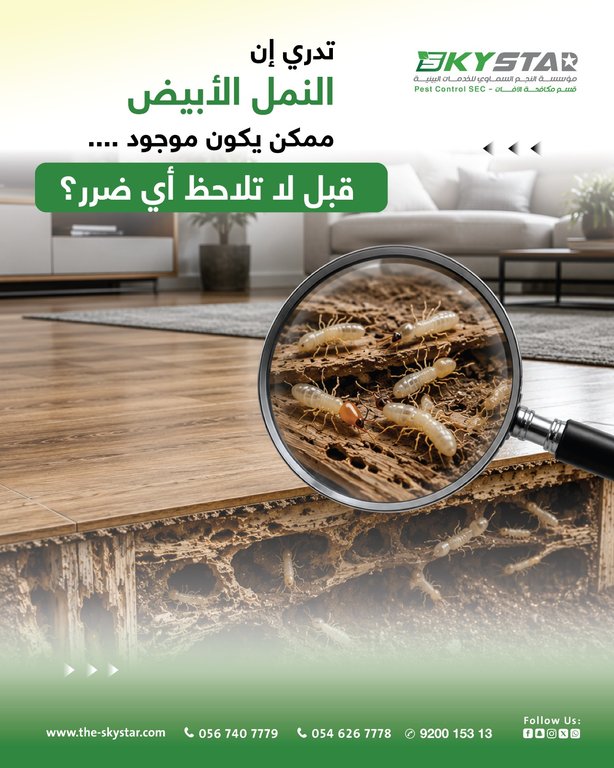
Rarely. It lives inside wood and soil and avoids light. What is usually seen are its signs: mud tunnels, hollow wood when tapped, and fallen wings near windows.
Q: The property is new, does it need inspection?
Yes, if you are receiving it from a contractor. The report documents its condition upon receipt and confirms the absence of any activity in the timber and surrounding area.
Q: Does the report replace the need for a structural engineer's inspection?
No. Our report concerns termites and other wood-destroying pests. If we find any damage that could affect structural integrity, we recommend consulting a qualified engineer.
Q: Do I need the seller's permission to inspect?
Yes, the owner should allow access to the property. Many sellers welcome this as it speeds up the sale.
Q: If you find an infestation, do I have to use your company for treatment?
No. The report is yours to use as you choose. If you would like us to carry out treatment, we provide a detailed quote.