
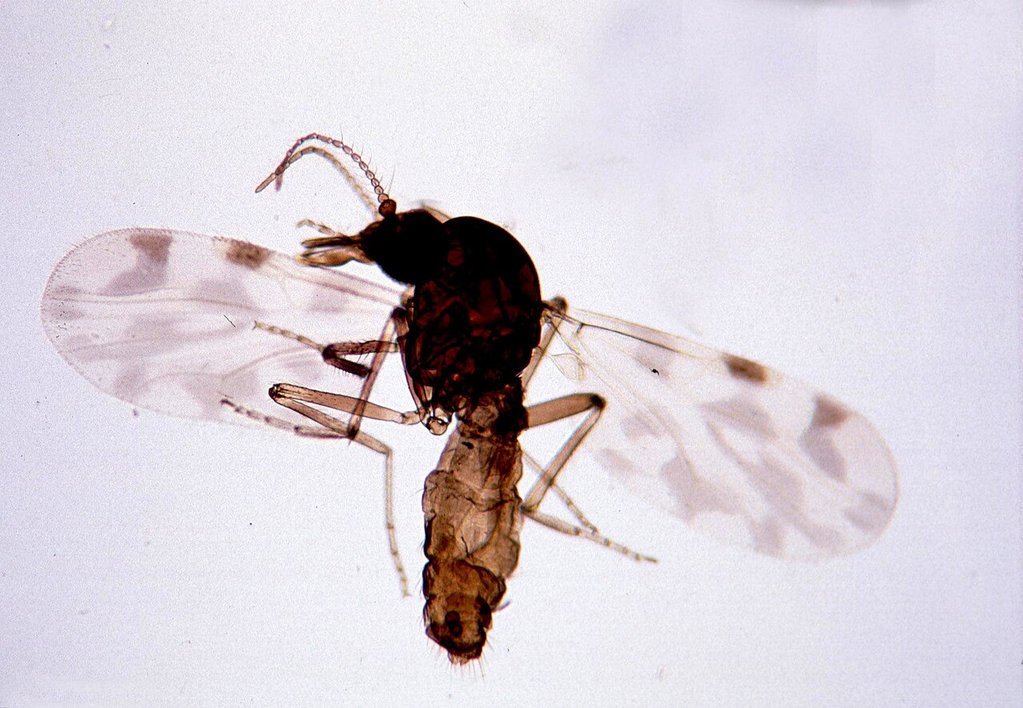
Scientific name: Culicoides imicola Family: Ceratopogonidae Order: Diptera Risk level: High Category: Flying pest
? What is the African biting midge
Scientific name: Culicoides imicola
Family: Ceratopogonidae
Order: Diptera
Risk level: High
Category: Flying pest
The midge (Culicoides imicola) is a tiny blood-feeding insect (1–3 mm), known in the Arab region as the sand gnat or biting midge. Only females bite because they need blood for reproduction. Despite its small size, its bite is very painful and causes noticeable swelling. Its major epidemiological importance is as a vector of bluetongue virus, which is devastating to livestock and sheep in the Gulf and Africa.
Life cycle of the African biting midge
It undergoes complete metamorphosis: egg, larva (three instars), pupa and adult. In suitable warm conditions, a generation takes 10–21 days. The female lays hundreds of eggs on suitable organic material.
Distribution of the African biting midge
It occurs in tropical and subtropical regions. In Saudi Arabia, the Gulf and Egypt, it is common in facilities associated with food, waste or decomposing organic material.
Damage and risks associated with the African biting midge
It transmits bluetongue virus to sheep and cattle, causing major economic losses to the livestock sector. Its bites can cause severe hypersensitivity in people. Some studies also report transmission of Rift Valley fever virus.
Signs of an African biting midge infestation
Signs include flies in food or production areas, increasing counts in ILT traps, and larvae at breeding sites.
Where African biting midges are found
They occur near stagnant, organically enriched water, including canal banks, wetlands, farm drainage areas and warm marshes. Larvae live in moist organic mud.
African biting midge control methods
Use ILTs with regular monitoring, outdoor ULV fogging, residual spraying on resting surfaces, treatment of breeding sources and air curtains at building entrances.
African biting midge control products
Pyrethroids (deltamethrin and cypermethrin), spinosad in sensitive areas, and diflubenzuron at breeding sites.
Requirements for controlling African biting midges in food facilities
FSSC 22000 Version 7/BRCGS: flies are a high-priority pest in food facilities. Their presence in production areas is a Major Non-Conformance. An ILT system with monthly documentation is required.
A fact about the African biting midge
The midge tracks its animal host with precision. It gathers where carbon dioxide and humidity are concentrated, which helps explain why it mainly attacks an animal’s neck and abdomen.
Frequently asked questions about the African biting midge
Q: How can I distinguish the African biting midge from a housefly?
A: Culicoides imicola is a tiny blood-feeding insect. Careful visual examination of size, color and behavior can help distinguish it from a housefly.
Q: Are ILTs enough to control flies?
A: ILTs alone are for monitoring and do not provide complete control. They must be combined with treatment of breeding sources and environmental management