
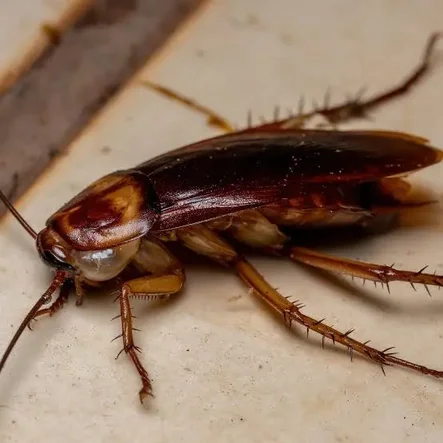
Scientific name: Periplaneta americana Family: Blattidae Order: Blattodea Risk level: Very high Category: Insect
What is the American cockroach?
Scientific name: Periplaneta americana
Family: Blattidae
Order: Blattodea
Risk level: Very high
Category: Insect
The American cockroach (Periplaneta americana) is the largest household cockroach, measuring 35–40 mm. It is reddish brown with a yellow halo on the pronotum. Despite its name, it originated in tropical Africa and spread around the world aboard commercial ships. It prefers warm, humid environments and is found mainly in sewer networks, basements and water pipes, making it a potential indicator of problems with a facility’s sanitary infrastructure.
Life cycle of the American cockroach
The American cockroach undergoes incomplete metamorphosis: an egg case (ootheca) containing 14–16 eggs, followed by 9–13 nymphal instars lasting 6–12 months, and then the adult, which lives for 1–2 years. A female produces 9–10 oothecae during her lifetime. The complete life cycle takes 14–24 months, depending on temperature. Adults develop wings and can fly in hot weather.
Distribution of the American cockroach
It is common worldwide and more prevalent in hot regions. In Saudi Arabia and the Gulf, it is frequently found in sewer networks, water-pumping stations, older hotels and hospitals, and large restaurants. It enters buildings through sewer pipes and ventilation openings.
Health risks and related problems
The American cockroach is a mechanical carrier of Salmonella, Escherichia coli, cholera and roundworms such as Ascaris. It carries bacteria on its body and feet, which may come into contact with garbage, feces and food in turn. Its association with sewer networks makes it an effective carrier of pathogens between drains and kitchens.
Signs of an American cockroach infestation
Signs include droppings larger than those of the German cockroach and cylindrical in shape; a characteristic unpleasant odor in infested areas; visible tracks in dusty locations; dark-brown oothecae packed into cracks; and sightings near sewer pipes and ventilation openings.
Where American cockroaches are found
Preferred environments include sewer networks, pump rooms, spaces beneath floors, damp basements and main restaurant drains. Inside buildings, they gather near heat and moisture sources, such as behind large ovens, under large cold-storage rooms and near sewer entrances.
American cockroach control methods
The priority is to address the sewer network. Install metal screens over drain openings and ventilation inlets. Place sticky traps inside utility rooms. Apply residual spray in drain channels and along pipe edges. Gel baits can be effective when entry points are also sealed.
American cockroach control products
Use pyrethroids for residual treatment in channels and cracks, gel baits near entry sources, and insect growth regulators (IGRs) such as pyriproxyfen at breeding sites. Specialized sewer pesticides may be used for microbial treatment of sewer systems.
Requirements for controlling American cockroaches in food facilities
FSSC 22000 Version 7: the American cockroach is listed as a high-risk pest in prerequisite programs (PRPs), and the standards require sewer-network treatment as part of pest-control programs. BRCGS: its presence in production areas is a Major Non-Conformance. HACCP plans must include entry sources from sewer systems.
A fact about the American cockroach
The American cockroach can run at a speed of 50 times its body length per second—about 1.5 m/s—making it one of the fastest insects relative to its size. It can also hang from ceilings and climb almost any surface except perfectly smooth ones.
Frequently asked questions about the American cockroach
Q: Why does the American cockroach suddenly appear in the kitchen?
A: It often indicates a connection to the sewer network. Checking drain openings and ensuring that inspection-chamber covers are tightly closed are essential first steps.
Q: Is pesticide spraying alone enough to control the American cockroach?
A: No. Effective control requires treating the sewer network and sealing all entry points. Spraying alone is temporary if the source is left untreated