
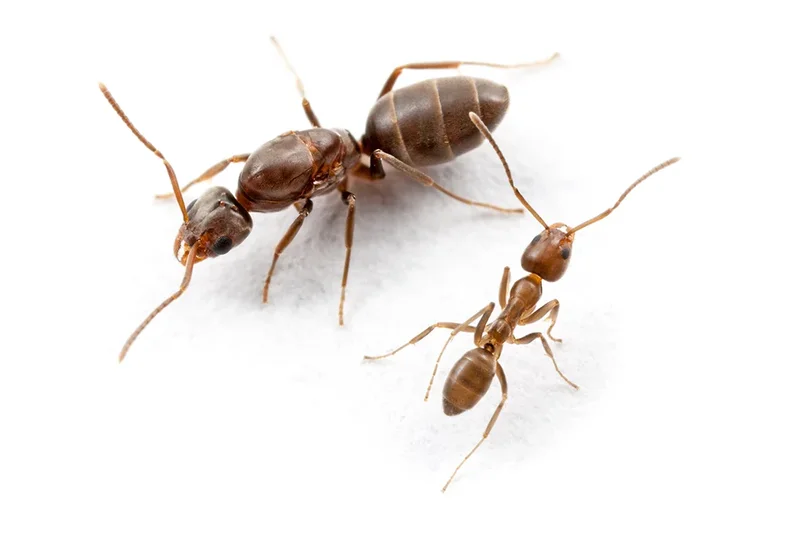
Scientific name: Linepithema humile Family: Formicidae Order: Hymenoptera Risk level: High Category: Insect
? What is the Argentine ant
Scientific name: Linepithema humile
Family: Formicidae
Order: Hymenoptera
Risk level: High
Category: Insect
The Argentine ant (Linepithema humile) is one of the world’s most dangerous invasive insects. It forms “supercolonies” that can extend for thousands of kilometers without boundaries between colonies. Members of the same species do not fight one another, allowing the ants to build vast networks that gradually displace native ant species and disrupt biodiversity.
Life cycle of the Argentine ant
Each colony has multiple queens. Reproductive flights do not occur. The ants spread through budding. Each queen produces 20–30 eggs per day.
Distribution of the Argentine ant
Native to Argentina, it has spread to Mediterranean and coastal regions with temperate climates. In the Gulf and Egypt, it occurs in coastal areas and major cities.
Damage and risks associated with the Argentine ant
It contaminates food sources and disrupts operations in restaurants and food facilities. It also affects biodiversity by displacing native species.
Signs of an Argentine ant infestation
Signs include dense trails of small (2.6 mm), grayish-brown ants on walls and floors, and groups gathering around sources of sugar, fats and protein.
Where Argentine ants are found
They occur wherever food and moisture are available, including around buildings, in gardens, on wet floors and in tile cracks beside water sources.
Argentine ant control methods
Treat foraging trails with slow-acting baits. Apply perimeter treatment around entry areas and manage nearby vegetation.
Argentine ant control products
Abamectin gel baits, liquid borates and pyrethroids for perimeter treatment.
Requirements for controlling Argentine ants in food facilities
FSSC/BRCGS: include this ant in pest-control plans. Its presence in a packaging area requires an investigation.
A fact about the Argentine ant
The Argentine ant has an exceptional chemical recognition system. It can distinguish colony members from foreign ants by smell and responds aggressively to outsiders, while treating ants from other Argentine colonies like nestmates. This helps explain the supercolonies that extend across continents.
Frequently asked questions about the Argentine ant
Q: How can I get rid of Argentine ants permanently?
A: Complete eradication is very difficult because of the supercolonies. A realistic goal is to control their numbers without putting the facility at risk. Ongoing baiting combined with environmental management is the best approach.
Q: Does it pose a direct health risk?
A: It does not sting people as painfully as the fire ant, but it contaminates food and indirectly affects food and operations