
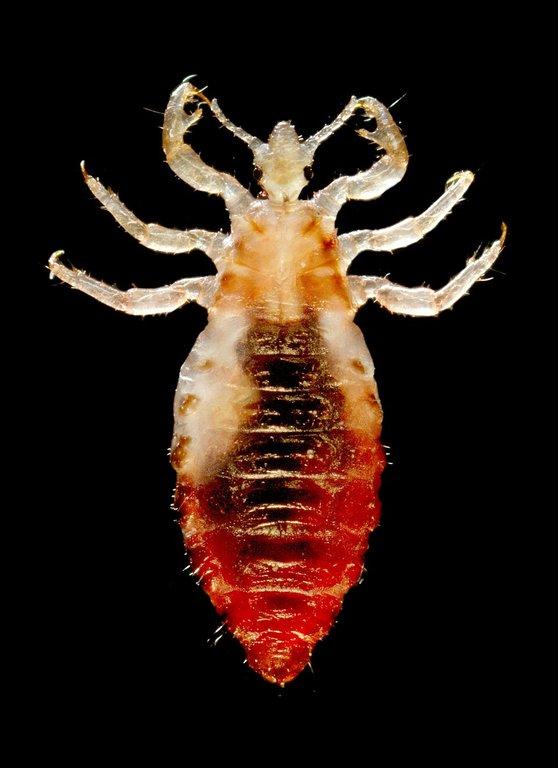
Scientific name: Pediculus humanus corporis Family: Pediculidae Order: Phthiraptera Risk level: High Category: Insect
? What is the body louse
Scientific name: Pediculus humanus corporis
Family: Pediculidae
Order: Phthiraptera
Risk level: High
Category: Insect
The body louse (Pediculus humanus corporis) is slightly larger than the head louse (2.3–3.6 mm) and differs greatly in behavior and risk. It lives in clothing fibers rather than directly on the skin and is a documented carrier of three serious human diseases: epidemic typhus (Rickettsia prowazekii), trench fever (Bartonella quintana) and relapsing fever (Borrelia recurrentis). Its role in historical epidemics has been devastating.
Life cycle of the body louse
It lives in clothing fibers and feeds on the skin five times a day. It lays 200–300 eggs in clothing and dies within days without a host.
Distribution of the body louse
It is associated with overcrowding, poverty and poor hygiene, including among refugees, in displacement camps, conflict zones and large work camps.
Damage and risks associated with the body louse
It can transmit epidemic typhus, which was fatal before antibiotics; trench fever, a mild but chronic relapsing fever; and relapsing fever caused by Borrelia recurrentis, a serious recurrent fever.
Signs of a body louse infestation
Signs include severe itching; small insects in the seams of underwear; blood spots on clothing from bites; and darkening of the skin in chronic cases (vagabond’s disease).
Where body lice are found
They are found in the fibers and folds of clothing, not on the body itself. Sleeping in the same clothing without changing creates ideal conditions.
Body louse control methods
Wash and heat-disinfect clothing at 60°C or higher. Bathe and change clothes. In severe cases, use topical insecticide on the body.
Body louse control products
Permethrin 5% cream for body treatment, malathion for resistant cases, and residual permethrin products for clothing.
Requirements for controlling body lice in food facilities
FSSC/BRCGS: body lice in employee housing require an immediate occupational-health protocol and isolation of clothing.
A fact about the body louse
The body louse is the only confirmed insect evidence that humans began wearing clothes. Genome analysis showed that it evolved specifically from the head louse when clothing emerged as a new habitat, between 72,000 and 170,000 years ago.
Frequently asked questions about body lice
Q: Can body lice affect a workplace outside a displacement camp?
A: This is rare in modern, well-resourced settings, but can occur in densely occupied worker housing. Preventive management through suitable housing and hygiene can prevent infestation.
Q: Are head lice and body lice the same insect?
A: They belong to the same species (Pediculus humanus), but over time became distinct subspecies adapted to different environments and associated risks