
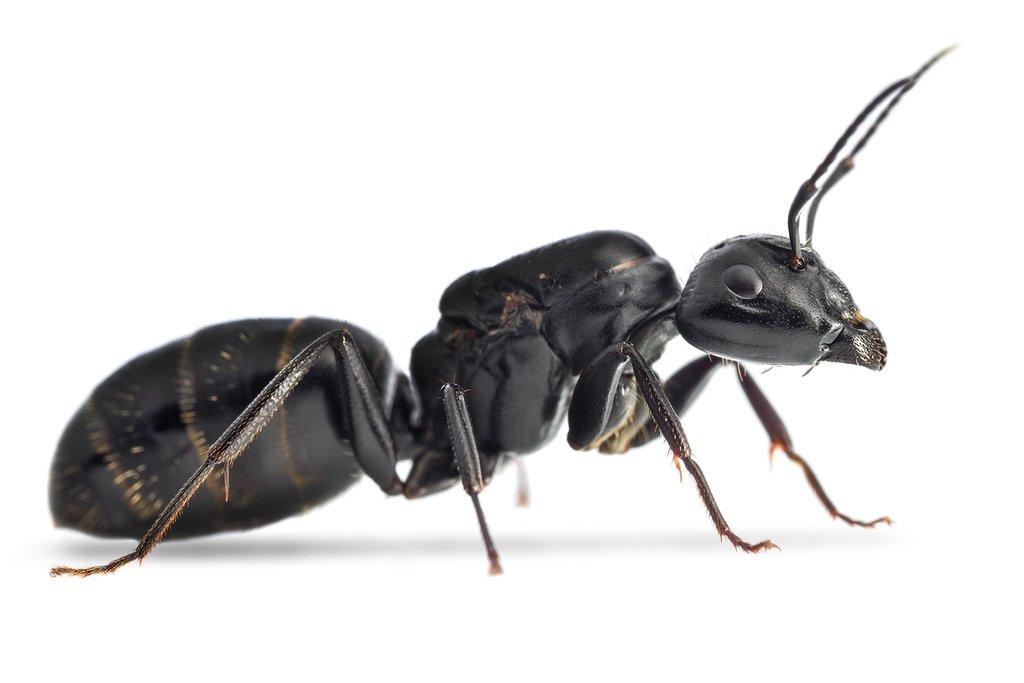
Scientific name: Camponotus pennsylvanicus Family: Formicidae Order: Hymenoptera Risk level: High Category: Insect
? What is the carpenter ant
Scientific name: Camponotus pennsylvanicus
Family: Formicidae
Order: Hymenoptera
Risk level: High
Category: Insect
Carpenter ants (Camponotus spp.) are the largest ants that infest buildings, measuring 6–12 mm; some major workers can reach 25 mm. Unlike termites, they do not eat wood; they excavate it to build nests. They prefer damp or decaying wood, so their presence is an important sign of a structural moisture problem. The characteristic chemical (formic acid) released when one is crushed helps identify the carpenter ant.
Life cycle of the carpenter ant
Colonies contain 3,000–10,000 individuals. The queen lives 15–25 years. Growth is slow, taking 3–6 years for a colony to reach full size. Alates fly in spring.
Distribution of the carpenter ant
It is widespread in North America, Europe and Asia. In the Gulf and Saudi Arabia, it occurs in older buildings and areas with large trees and damp wood.
Damage and risks associated with the carpenter ant
It damages damp structural wood, including roof beams and foundations, and is a key indicator of hidden water leaks.
Signs of a carpenter ant infestation
Signs include fine sawdust mixed with insect fragments outside wood cavities; clean, smooth galleries inside wood when inspected; and sightings of large black ants along trails at night.
Where carpenter ants are found
They occur in damp wood, including wet roof beams and window frames with leaks, and in nearby hollow trees, which are often the main nesting source.
Carpenter ant control methods
Repair moisture sources first; this is more important than any pesticide. Prune trees. Apply residual spray along ant trails and at entry points. Gel baits can be effective.
Carpenter ant control products
Pyrethroids (bifenthrin and deltamethrin) for residual spraying, abamectin gel baits, and diatomaceous powder in wood cavities.
Requirements for controlling carpenter ants in food facilities
FSSC/BRCGS: carpenter ants indicate a structural moisture problem that must be documented and reported to facility management.
A fact about the carpenter ant
Carpenter ants keep their wooden galleries exceptionally clean. They regularly remove droppings, dead insects and wood shavings from the nest. Finding frass outside the wood is therefore a reliable sign of an active nest.
Frequently asked questions about the carpenter ant
Q: Does the carpenter ant destroy wood like a termite?
A: The damage is different: carpenter ants excavate wood for shelter without eating it, while termites eat it. Termites are more destructive to load-bearing structures, but carpenter ants are a serious indicator of moisture problems.
Q: What is the first step when carpenter ants are discovered?
A: Arrange a moisture inspection of the building and look for leaks and damp wood. Treating the moisture source is more important than spraying pesticide