
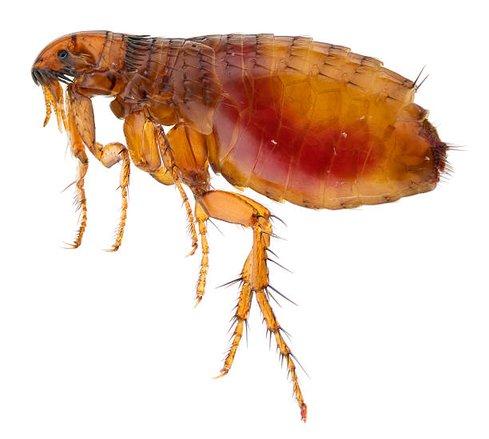
Scientific name: Ctenocephalides felis Family: Pulicidae Order: Siphonaptera Risk level: High Category: Insect
? What is the cat flea
Scientific name: Ctenocephalides felis
Family: Pulicidae
Order: Siphonaptera
Risk level: High
Category: Insect
The cat flea (Ctenocephalides felis) is the world’s most common flea and infests cats, dogs and people. Its dark-brown body is flattened from side to side and measures 1.5–3.3 mm, allowing it to move quickly through fur. It can jump 33 cm horizontally and 18 cm vertically—about 150 times its body length. It is an intermediate host of the tapeworm Dipylidium caninum and a potential carrier of Bartonella bacteria.
Life cycle of the cat flea
The flea develops through four stages: egg, larva (three instars), pupa and adult. Eggs are laid on the host but fall into the environment. Larvae develop in carpets and furniture over 2–3 weeks. Pupae can remain dormant for months until they detect vibration. In summer, the full generation takes 3–4 weeks.
Distribution of the cat flea
It is found worldwide and is associated with pets. In the Gulf and Saudi Arabia, it is common in homes, pet hotels and poultry farms.
Damage and risks associated with the cat flea
It causes painful, irritating bites and allergic skin reactions known as flea allergy dermatitis (FAD). It can transmit tapeworms and Bartonella (cat-scratch fever), and, rarely, murine typhus.
Signs of a cat flea infestation
Signs include persistent itching in pets and people; red bites on the ankles and legs; flea dirt (small black granules) in an animal’s fur that turns red when wet; and visible fleas jumping in carpets.
Where cat fleas are found
Larvae and pupae occur in carpets, upholstered furniture and pet bedding. Adults live on the animal, and fleas may also be found in cracks in parquet floors.
Cat flea control methods
Treat the pet with approved veterinary products (fipronil or selamectin). Treat the entire environment by spraying the home with pyrethroids and IGRs. Wash bedding and carpets with heat, and vacuum daily during treatment.
Cat flea control products
Use environmental pyrethroids (permethrin) with imidacloprid or the IGR methoprene. Apply the IGR pyriproxyfen where larvae gather.
Requirements for controlling cat fleas in food facilities
FSSC/BRCGS: fleas in food facilities are a Major Non-Conformance. Working or authorized animals at the facility must be inspected.
A fact about the cat flea
The cat flea can jump from one surface to another with acceleration of 140 G—about 50 times the acceleration of a space rocket at launch. This is the highest documented natural acceleration in insects and is achieved through an elastic protein in the thorax that stores energy like a spring.
Frequently asked questions about the cat flea
Q: We treated our pet, but fleas are still in the house. Why?
A: Because most of the flea population (90%) is in the environment as eggs, larvae and pupae, not on the animal. Treating the animal alone reduces the population but does not eliminate it. The entire home must be treated.
Q: How long does complete flea control take?
A: Usually 4–8 weeks because the pupal stage is protected. Continue environmental treatment and weekly pet treatment during this period