
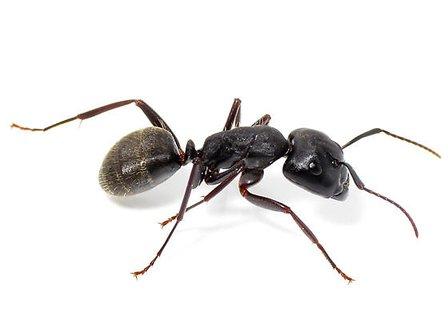
Scientific name: Paratrechina longicornis Family: Formicidae Order: Hymenoptera Risk level: Moderate Category: Insect
? What is the crazy ant
Scientific name: Paratrechina longicornis
Family: Formicidae
Order: Hymenoptera
Risk level: Moderate
Category: Insect
The crazy ant, also called the longhorn crazy ant (Paratrechina longicornis), is known for its rapid, erratic movement, which gave it its name. It has exceptionally long antennae for its size and is glossy black; it measures 3.1 mm. It adapts to many environments and spreads efficiently through ports and warehouses.
Life cycle of the crazy ant
Colonies have multiple queens. There is no major reproductive flight. The ant spreads through budding and international trade.
Distribution of the crazy ant
It is one of the ant species most widely spread through international trade. It occurs in ports and warehouses in Saudi Arabia and the Gulf.
Damage and risks associated with the crazy ant
It contaminates food and surfaces and may affect electronic equipment.
Signs of a crazy ant infestation
Signs include the distinctive rapid, erratic movement of glossy black ants and groups gathering around sugar and protein sources in warehouses.
Where crazy ants are found
They occur along storage-box edges, at loading entrances and in wall cracks near food sources.
Crazy ant control methods
Use gel baits, treat incoming shipments and monitor ports.
Crazy ant control products
Imidacloprid or abamectin gel baits.
Requirements for controlling crazy ants in food facilities
FSSC/BRCGS: include the crazy ant in monitoring plans for warehouses and ports.
A fact about the crazy ant
The ant was given this name because early researchers thought its erratic movement indicated a nervous-system disorder. Research later showed that the movement is organized and maximizes food-search efficiency by covering the area thoroughly.
Frequently asked questions about the crazy ant
Q: How is the crazy ant different from the ghost ant?
A: The crazy ant is larger (3.1 mm), entirely glossy black, and moves rapidly and erratically. The ghost ant is smaller, has a partly translucent lower body and moves in a relatively more orderly way.
Q: Does it affect electronic equipment?
A: Yes. It has been implicated in electronic equipment failures in warehouses after building trails inside devices