
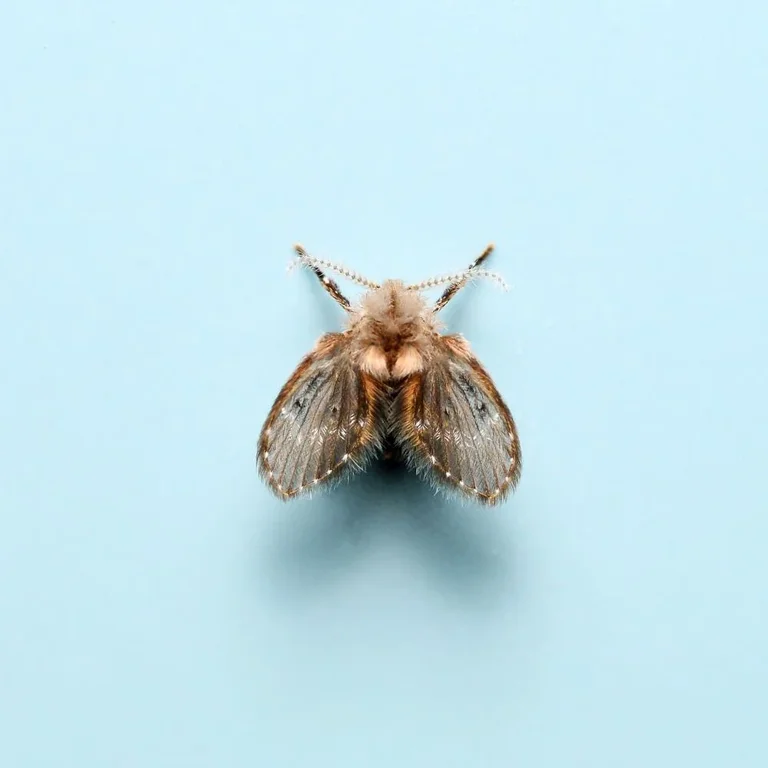
Scientific name: Psychoda alternata Family: Psychodidae Order: Diptera Risk level: Moderate Category: Flying pest
? What is the drain fly
Scientific name: Psychoda alternata
Family: Psychodidae
Order: Diptera
Risk level: Moderate
Category: Flying pest
The drain fly (Psychoda alternata) is much smaller than the housefly (1.5–5 mm). Its broad wings are covered with fine hairs and resemble the wings of a tiny moth. It develops exclusively in organic material accumulated in drains and sewer screens. Its presence is a reliable indicator of a blocked drain or a buildup of algae and grease in drains.
Life cycle of the drain fly
It undergoes complete metamorphosis: egg, larva (three instars), pupa and adult. In suitable warm conditions, a generation takes 10–21 days. The female lays hundreds of eggs on suitable organic material.
Distribution of the drain fly
It occurs in tropical and subtropical regions. In Saudi Arabia, the Gulf and Egypt, it is common in facilities associated with food, waste or decomposing organic material.
Damage and risks associated with the drain fly
Large breeding populations are very irritating. It rarely causes disease, but indicates sanitation problems in drains. It may rarely cause myiasis.
Signs of a drain fly infestation
Signs include flies in food or production areas, increasing counts in ILT traps, and larvae at breeding sites.
Where drain flies are found
They occur in biofilm in kitchen and washroom drains, wastewater plants and unclean wastewater tanks. Larvae live in the biofilm attached to drain walls.
Drain fly control methods
Use ILTs with regular monitoring, outdoor ULV fogging, residual spraying on resting surfaces, treatment of breeding sources and air curtains at building entrances.
Drain fly control products
Pyrethroids (deltamethrin and cypermethrin), spinosad in sensitive areas, and diflubenzuron at breeding sites.
Requirements for controlling drain flies in food facilities
FSSC 22000 Version 7/BRCGS: flies are a high-priority pest in food facilities. Their presence in production areas is a Major Non-Conformance. An ILT system with monthly documentation is required.
A fact about the drain fly
The drain fly’s full life cycle takes 21 days: the egg stage lasts 48 hours, the larval stage 9–15 days in biofilm, and the pupal stage 20–40 hours. Rapid reproduction means a single neglected drain can produce thousands of flies each week.
Frequently asked questions about the drain fly
Q: How can I distinguish a drain fly from a housefly?
A: The drain fly (Psychoda alternata) is much smaller than the housefly. Careful visual examination of size, color and behavior can help distinguish the two.
Q: Are ILTs enough to control flies?
A: ILTs alone are for monitoring and do not provide complete control. They must be combined with treatment of breeding sources and environmental management