
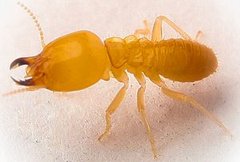
? What is the drywood termite
Scientific name: Cryptotermes brevis
Family: Kalotermitidae
Order: Isoptera
Risk level: High
Category: Insect
The drywood termite (Cryptotermes brevis) differs fundamentally from subterranean termites: it lives inside dry wood and forms independent colonies without needing contact with soil or external water sources. Its colony is relatively small (2,000–5,000 individuals), but large enough to destroy furniture, wooden frames and doors. It is one of the pests most commonly spread through international shipping because it travels inside furniture and timber.
Life cycle of the drywood termite
A colony begins with a pair of winged reproductives. Growth is slow; a mature colony takes 5–10 years to develop. Soldiers have large, solid black heads.
Distribution of the drywood termite
It is widespread throughout tropical and subtropical regions. It entered the Gulf and Saudi Arabia in imported furniture and timber.
Damage and risks associated with the drywood termite
It can extensively damage valuable wooden furniture, door and window frames, and wooden panels in facilities.
Signs of a drywood termite infestation
Signs include hard, white fecal pellets (frass) with a distinctive peppercorn-like shape; small holes 2–3 mm wide in wood; and a hollow sound when the wood is tapped.
Where drywood termites are found
They live inside wooden furniture, door and window frames, solid-wood panels, antiques and rare wooden objects.
Drywood termite control methods
Whole-building heat treatment raises the temperature of the wood to 56°C. Fumigation with methyl bromide or phosphine can be carried out under tarpaulins. Infested wood can also be injected with pesticides.
Drywood termite control products
Fumigation with methyl bromide or sulfuryl fluoride (Vikane), injection of pyrethroids into wood, and spot treatment with borates.
Requirements for controlling drywood termites in food facilities
FSSC/BRCGS: imported wooden furniture must be inspected, and treatment certificates must be documented as a condition of accepting shipments.
A fact about the drywood termite
Drywood termites can spread within a building by swarming to nearby wood during the reproductive season. This process may go undetected for years because newly formed colonies do not produce enough frass for a long period.
Frequently asked questions about the drywood termite
Q: Can an infested piece of furniture be treated without treating the whole building?
A: Yes. A limited infestation can be treated by injecting pesticide into the item or using partial heat treatment. If several items are infested, building fumigation is recommended.
Q: Is treated furniture safe to use immediately after fumigation?
A: After sulfuryl fluoride fumigation, the building can be re-entered within hours once it has been checked with instruments. Methyl bromide requires a longer ventilation period