
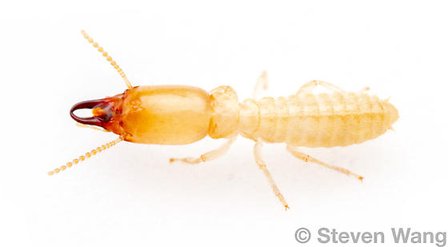
Scientific name: Reticulitermes flavipes Family: Rhinotermitidae Order: Isoptera Risk level: Very high Category: Insect
? What is the Eastern subterranean termite
Scientific name: Reticulitermes flavipes
Family: Rhinotermitidae
Order: Isoptera
Risk level: Very high
Category: Insect
The Eastern subterranean termite (Reticulitermes flavipes) is described as the most widespread termite species worldwide and causes major economic losses to wooden structures. It lives in soil and builds mud tubes that let it reach wood without being exposed to drying conditions. Workers are pale and lack functional eyes, while soldiers have elongated brown heads and large jaws.
Life cycle of the Eastern subterranean termite
A colony contains 20,000 to one million individuals. The queen lays 2,000–10,000 eggs per year. The first generation takes 3–5 years to develop.
Distribution of the Eastern subterranean termite
It occurs on every continent. It is a major pest in the Middle East and Gulf region, particularly in older buildings near damp soil.
Damage and risks associated with the Eastern subterranean termite
It causes silent structural damage to load-bearing wood, which can lead to sudden collapse in structures with advanced infestations.
Signs of an Eastern subterranean termite infestation
Signs include mud tubes 6–15 mm wide on walls and foundations; wood that looks sound outside but is hollow inside; and white, waxy frass near wood.
Where Eastern subterranean termites are found
They occur in soil beside building foundations, lower wooden beams, wooden floors, and door frames in contact with soil or moisture.
Eastern subterranean termite control methods
Treat the soil with termiticides before and during construction. Create a chemical or physical barrier in foundation soil. Use baiting systems for active colonies.
Eastern subterranean termite control products
Fipronil is used for soil barriers, imidacloprid in baiting systems, and chlorantraniliprole as a newer alternative.
Requirements for controlling Eastern subterranean termites in food facilities
FSSC/BRCGS: all wooden structures must be inspected annually. The report from an accredited external inspector is part of the required documentation.
A fact about the Eastern subterranean termite
Reticulitermes termites use a complex tunnel network for chemical communication through pheromones. Colony members recognize one another by colony-specific pheromones and can distinguish their own colony from other colonies of the same species.
Frequently asked questions about the Eastern subterranean termite
Q: How long does termite treatment take?
A: Soil treatment is applied in one day, but monitoring continues for 3–6 months. Baiting systems take 3–9 months to eliminate a colony.
Q: Do baiting systems really work?
A: Yes, provided the bait is selected and placed correctly and technicians carry out regular follow-up. They are an excellent option where soil treatment is not possible