
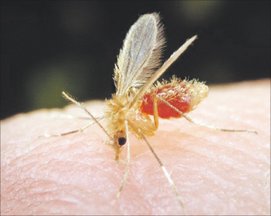
Scientific name: Phlebotomus papatasi Family: Psychodidae Order: Diptera Risk level: Very high Category: Flying pest
? What is the Egyptian sand fly
Scientific name: Phlebotomus papatasi
Family: Psychodidae
Order: Diptera
Risk level: Very high
Category: Flying pest
The Egyptian sand fly (Phlebotomus papatasi) is a blood-feeding insect of major epidemiological importance in the Middle East and North Africa. It is very small (1.5–3.5 mm) and has a distinctive upright wing posture. It is the main vector of Leishmania species, which cause cutaneous and visceral leishmaniasis (kala-azar), as well as sandfly fever. It is active at night and around dawn.
Life cycle of the Egyptian sand fly
It undergoes complete metamorphosis: egg, larva (three instars), pupa and adult. In suitable warm conditions, a generation takes 10–21 days. The female lays hundreds of eggs on suitable organic material.
Distribution of the Egyptian sand fly
It occurs in tropical and subtropical regions. In Saudi Arabia, the Gulf and Egypt, it is common in facilities associated with food, waste or decomposing organic material.
Damage and risks associated with the Egyptian sand fly
It is a main vector of cutaneous leishmaniasis (“Aleppo boil” or “Baghdad boil”) and the potentially fatal visceral form (kala-azar). It also transmits sandfly fever, a short-lived acute fever. Saudi Arabia, Yemen and Egypt are documented endemic areas.
Signs of an Egyptian sand fly infestation
Signs include flies in food or production areas, increasing counts in ILT traps, and larvae at breeding sites.
Where Egyptian sand flies are found
They occur in caves, cracks in mud and rock walls, tree cavities, rodent nests, and muddy ground near rural buildings. They breed in moist soil rich in organic material.
Egyptian sand fly control methods
Use ILTs with regular monitoring, outdoor ULV fogging, residual spraying on resting surfaces, treatment of breeding sources and air curtains at building entrances.
Egyptian sand fly control products
Pyrethroids (deltamethrin and cypermethrin), spinosad in sensitive areas, and diflubenzuron at breeding sites.
Requirements for controlling Egyptian sand flies in food facilities
FSSC 22000 Version 7/BRCGS: flies are a high-priority pest in food facilities. Their presence in production areas is a Major Non-Conformance. An ILT system with monthly documentation is required.
A fact about the Egyptian sand fly
Sand flies do not buzz. Their flight is completely silent, making personal protective measures especially important because people cannot hear them approaching.
Frequently asked questions about the Egyptian sand fly
Q: How can I distinguish an Egyptian sand fly from a housefly?
A: The Egyptian sand fly (Phlebotomus papatasi) is a very small blood-feeding insect. Careful visual examination of size, color and behavior can help distinguish the two.
Q: Are ILTs enough to control flies?
A: ILTs alone are for monitoring and do not provide complete control. They must be combined with treatment of breeding sources and environmental management