
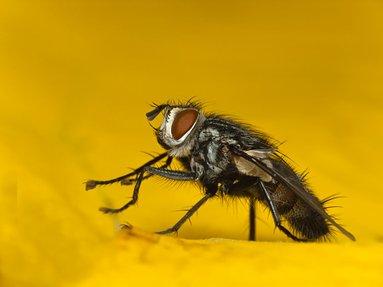
Scientific name: Sarcophaga carnaria Family: Sarcophagidae Order: Diptera Risk level: High Category: Flying pest
? What is the flesh fly
Scientific name: Sarcophaga carnaria
Family: Sarcophagidae
Order: Diptera
Risk level: High
Category: Flying pest
The flesh fly (Sarcophaga carnaria) has a gray, striped body with three longitudinal black stripes on the thorax and large red eyes. It measures 8–10 mm. A distinctive biological feature is that it deposits live larvae directly on food or wounds (larviparity) instead of laying eggs, greatly accelerating colonization and making detection more difficult.
Life cycle of the flesh fly
It undergoes complete metamorphosis: egg, larva (three instars), pupa and adult. In suitable warm conditions, a generation takes 10–21 days. The female lays hundreds of eggs on suitable organic material.
Distribution of the flesh fly
It occurs in tropical and subtropical regions. In Saudi Arabia, the Gulf and Egypt, it is common in facilities associated with food, waste or decomposing organic material.
Damage and risks associated with the flesh fly
It deposits live larvae on meat, fish and open wounds. It can cause myiasis in animals and mechanically carry pathogens.
Signs of a flesh fly infestation
Signs include flies in food or production areas, increasing counts in ILT traps, and larvae at breeding sites.
Where flesh flies are found
They occur around exposed meat, open wounds, organic food remains and solid waste in slaughterhouses.
Flesh fly control methods
Use ILTs with regular monitoring, outdoor ULV fogging, residual spraying on resting surfaces, treatment of breeding sources and air curtains at building entrances.
Flesh fly control products
Pyrethroids (deltamethrin and cypermethrin), spinosad in sensitive areas, and diflubenzuron at breeding sites.
Requirements for controlling flesh flies in food facilities
FSSC 22000 Version 7/BRCGS: flies are a high-priority pest in food facilities. Their presence in production areas is a Major Non-Conformance. An ILT system with monthly documentation is required.
A fact about the flesh fly
Flesh flies are among the few insects documented to cause myiasis in human body cavities, including the nose, ear and wounds. During World War I, their larvae helped save the lives of wounded soldiers by debriding wounds before antibiotics were discovered.
Frequently asked questions about the flesh fly
Q: How can I distinguish a flesh fly from a housefly?
A: The flesh fly (Sarcophaga carnaria) has a gray striped body. Careful visual examination of size, color and behavior can help distinguish the two.
Q: Are ILTs enough to control flies?
A: ILTs alone are for monitoring and do not provide complete control. They must be combined with treatment of breeding sources and environmental management