
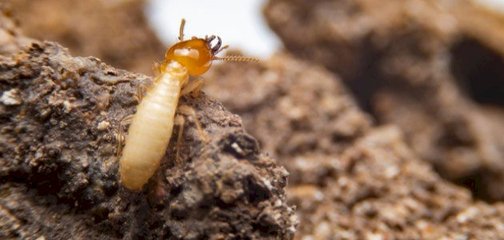
Scientific name: Coptotermes formosanus Family: Rhinotermitidae Order: Isoptera Risk level: Very high Category: Insect
? What is the Formosan subterranean termite
Scientific name: Coptotermes formosanus
Family: Rhinotermitidae
Order: Isoptera
Risk level: Very high
Category: Insect
The Formosan subterranean termite (Coptotermes formosanus) is described as the most destructive and widespread subterranean termite worldwide and is nicknamed the “super termite.” It builds huge colonies containing several million individuals and silently damages wooden structures in buildings, bridges and ships, as well as utility poles. Workers are beige to white with oval heads. They have glands that release a sticky substance used to strengthen the termite’s constructions.
Life cycle of the Formosan subterranean termite
A colony can grow to several million individuals within 3–5 years. The queen lays tens of thousands of eggs each year and lives for decades. Reproductive alates fly in spring and summer to establish new colonies.
Distribution of the Formosan subterranean termite
Native to southern China, it has spread worldwide aboard cargo ships. In the Gulf and Saudi Arabia, it has been reported at ports, in imported-goods facilities and in older buildings.
Damage and risks associated with the Formosan subterranean termite
It causes severe structural damage that can put building safety at risk. It costs billions of dollars each year in the United States alone. In food facilities, products may be contaminated by its droppings and sticky secretions.
Signs of a Formosan subterranean termite infestation
Signs include emerging alates (winged insects) during the reproductive season, mud tubes on surfaces and walls, hollow-sounding wood when tapped, and small white frass pellets.
Where Formosan subterranean termites are found
They infest structural wood in building foundations, roof beams, wooden doors and wall panels, as well as damp, dark areas near water sources.
Formosan subterranean termite control methods
Prevention: treat the soil with termiticides before construction. Treatment: apply termiticide to soil around foundations, use baiting systems, and inject treatment directly into infested wood.
Formosan subterranean termite control products
Use phenylpyrazole compounds (fipronil) for soil treatment, imidacloprid in baiting systems, and bifenthrin for residual spraying around foundations.
Requirements for controlling Formosan subterranean termites in food facilities
FSSC 22000/BRCGS: termites are a high-priority structural pest. All facilities require an annual structural inspection with documented results. Any structural damage requires immediate notification.
A fact about the Formosan subterranean termite
To detect underground tunnels, some advanced pest-control companies use ground-penetrating radar (GPR) and acoustic sensors that detect chewing and construction sounds within wood and soil.
Frequently asked questions about the Formosan subterranean termite
Q: How can I detect Formosan subterranean termites before damage occurs?
A: Conduct regular inspections using acoustic and thermal devices, and check mud tubes and soil-contact areas. Do not wait for visible wood deformation.
Q: Is soil treatment alone sufficient?
A: For large Formosan subterranean termite colonies, combining soil treatment with baiting systems is recommended for maximum effectiveness