
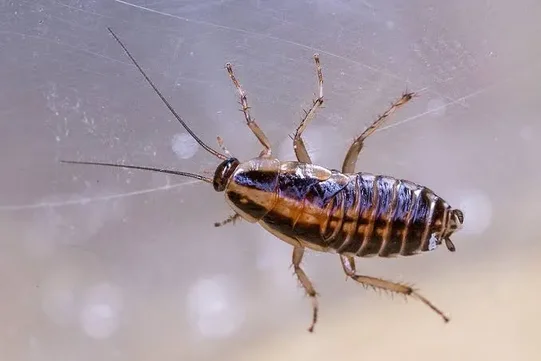
Scientific name: Blattella germanica Family: Ectobiidae Order: Blattodea Risk level: Very high Category: Insect
What is the German cockroach?
Scientific name: Blattella germanica
Family: Ectobiidae
Order: Blattodea
Risk level: Very high
Category: Insect
The German cockroach (Blattella germanica) is one of the most widespread and serious insect pests in food-processing facilities, hotels and hospitals worldwide. Adults measure 12–17 mm long and are light brown, with two distinct dark longitudinal stripes on the pronotum. They have wings but rarely fly, relying instead on rapid running to move around. They prefer warm, humid environments with temperatures of 25–33°C and are mainly active in the dark, which can make early infestations difficult to detect.
Life cycle of the German cockroach
The insect passes through three main stages: egg within an ootheca, nymph and adult. The female produces an ootheca containing 30–40 eggs and carries it until shortly before hatching. Over her lifetime, she produces 4–8 oothecae. The nymph passes through 6–7 instars over 6–12 weeks. Adults live for 6–12 months and begin reproducing within two weeks of reaching maturity. Under ideal conditions, one pair can produce more than 35,000 insects in a year, making early control critical.
Distribution of the German cockroach
The German cockroach occurs worldwide on every continent except the polar regions. In the Arabian Gulf and Saudi Arabia, it is among the pests most frequently reported in restaurants, hotels, food-processing facilities and hospitals. It spreads through food and logistics supply chains and in boxes, used equipment and clothing. It is considered highly resistant to pesticides, in part because of excessive and poorly targeted pesticide use.
Health risks and related problems
The German cockroach is a mechanical carrier of more than 40 types of pathogens, including Salmonella, Escherichia coli (E. coli), Staphylococcus, Shigella, Clostridium and hepatitis viruses. It is also a major source of allergens associated with allergies and asthma: its droppings and secretions can trigger acute allergic reactions, particularly in children and people who are ill. The source states that chronic exposure to its allergens increases the risk of chronic asthma by 50%.
Signs of a German cockroach infestation
Common signs include droppings resembling small dark coffee grounds in corners and cracks; a distinctive oily, unpleasant odor; small brown egg cases (oothecae) behind electrical appliances; and translucent shed skins in narrow gaps. Seeing cockroaches during the day indicates a heavy infestation. Ultraviolet (UV) light and sticky traps can be used to assess the level of infestation.
Where German cockroaches are found
Indoors, they hide behind refrigerators, ovens, washing machines and other large appliances; in wall gaps and suspended ceilings; in spaces under 6 mm wide between appliances and walls; behind kitchen partition panels; and under sinks or near water sources. Outdoors, they may be found around waste containers, loading and shipping areas, and openings in walls.
German cockroach control methods
Prevention: seal all gaps and cracks wider than 1 mm, isolate food and water sources, apply the 5S system, and inspect incoming shipments. Monitoring: place sticky traps at critical points, check them weekly and analyze trends. Control: apply gel baits specifically at activity points, use crack-and-crevice treatments, and rotate active ingredients to help prevent resistance.
German cockroach control products
Group 1, gel baits: imidacloprid, hydramethylnon and fipronil, with a transfer effect (the “domino effect”). Group 2, residual sprays: deltamethrin, cypermethrin and permethrin, which are fast-acting pyrethroids. Group 3, insect growth regulators (IGRs): pyriproxyfen and hydroprene, which prevent completion of the life cycle. Warning: avoid widespread spraying in areas containing gel baits; the repellent odor can interfere with bait effectiveness.
Requirements for controlling German cockroaches in food facilities
FSSC 22000 Version 7: the German cockroach is included in the risk assessment plan (PRP) as a high-risk pest in food facilities. Monitoring points and monthly trend analyses must be documented. BRCGS: cockroach droppings in a production area constitute a Major Non-Conformance requiring an immediate stoppage. The pest must also be listed in the HACCP plan as a Biological Hazard with a Control Point (CP).
A fact about the German cockroach
The German cockroach has a highly sensitive sensory system. Cerci around its body detect vibration and movement, enabling it to respond to a threat in less than 50 milliseconds—faster than a conscious human response. It can also survive for a full week without its head before dying from dehydration.
Frequently asked questions about the German cockroach
Q: Why do I still see cockroaches despite repeated spraying?
A: The most common reasons are acquired chemical resistance, an untreated harborage, or reinfestation from an external source. The suggested response is to switch to gel baits and identify and seal infestation sources.
Q: What is the difference between German and American cockroaches?
A: The German cockroach is smaller (12–17 mm), reproduces faster and is more resistant to pesticides. The American cockroach is larger (35–40 mm) and prefers sewers and humid environments. Each requires a different control protocol.
Q: Does the German cockroach transmit diseases directly?
A: It transmits them mechanically: it carries pathogens on its body and in its droppings, but is not a biological vector. A cockroach can carry thousands of pathogens, especially after moving between garbage areas and food