
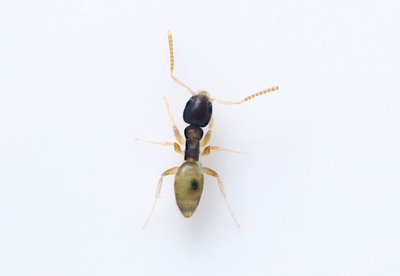
Scientific name: Tapinoma melanocephalum Family: Formicidae Order: Hymenoptera Risk level: Moderate Category: Insect
? What is the ghost ant
Scientific name: Tapinoma melanocephalum
Family: Formicidae
Order: Hymenoptera
Risk level: Moderate
Category: Insect
The ghost ant (Tapinoma melanocephalum) is named for the largely translucent body that makes it very difficult to see with the naked eye. Its head and thorax are dark brown, while its abdomen and legs are translucent white. It is very small (1.3–1.5 mm) and moves quickly. It prefers damp areas and is concentrated in bathrooms, kitchens and luxury hotels.
Life cycle of the ghost ant
Colonies have multiple queens and spread by budding, like Pharaoh ants. Colonies contain 100–1,000 individuals. The complete life cycle takes 75 days.
Distribution of the ghost ant
It is widespread in tropical and subtropical regions. In the Gulf, Saudi Arabia and Egypt, it occurs in hotels, hospitals, residential complexes and food facilities.
Damage and risks associated with the ghost ant
It contaminates food by walking over food-contact surfaces. In hospitals, it may transmit pathogens in a way similar to the Pharaoh ant.
Signs of a ghost ant infestation
Signs include very fine trails of translucent ants, groups around water droplets and sources of moisture, and ants in folds of hotel towels.
Where ghost ants are found
They occur in damp wall cracks, under tiles, around water pipes, in damp kitchen crevices and in air-conditioned rooms with high humidity.
Ghost ant control methods
Use slow-acting gel baits—do not spray. Treat moisture sources and seal cracks.
Ghost ant control products
Gel baits containing imidacloprid or abamectin.
Requirements for controlling ghost ants in food facilities
FSSC/BRCGS: include the ghost ant in pest-control plans and treat it as a high-priority pest in hotels and hospitals.
A fact about the ghost ant
When crushed, the ghost ant releases a coconut-like odor caused by the chemical 6-methyl-5-hepten-2-one, which it releases as a chemical warning to the colony. The smell is faint but can be detected by crushing an ant between the fingers.
Frequently asked questions about the ghost ant
Q: Why is the ghost ant difficult to see?
A: Its translucent abdomen and legs make it almost invisible on light-colored surfaces. Using angled or magnifying light can help track its trails.
Q: Does it appear in hotel guest rooms?
A: Yes. It is one of the pests most often behind hotel guest complaints and can be found in bathrooms and small kitchens inside guest rooms