
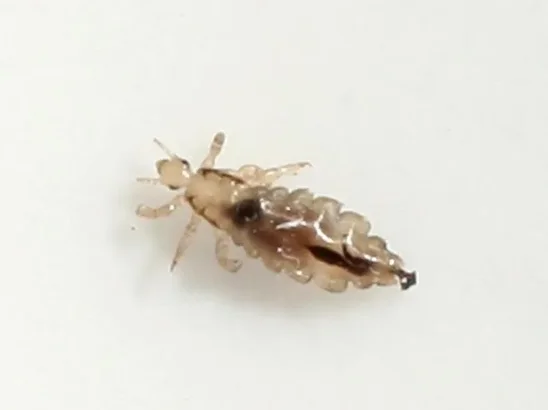
Scientific name: Pediculus humanus capitis Family: Pediculidae Order: Phthiraptera Risk level: Moderate Category: Insect
? What is the head louse
Scientific name: Pediculus humanus capitis
Family: Pediculidae
Order: Phthiraptera
Risk level: Moderate
Category: Insect
The head louse (Pediculus humanus capitis) is an obligate parasite of the human scalp. It does not live in the external environment and does not infest animals. It measures 2.1–3.3 mm and is translucent gray, turning reddish brown after feeding. It is one of the most common infestations among schoolchildren, with hundreds of millions of cases estimated worldwide each year. It is not known to transmit disease, but causes severe itching and social and psychological distress.
Life cycle of the head louse
The egg (nit) is attached to hair near the scalp. It then passes through three nymphal stages over 9–12 days. An adult lives for 30–40 days and lays 3–5 eggs per day.
Distribution of the head louse
It is found worldwide. School-age children are most affected. It spreads through direct hair-to-hair contact, not through the air, swimming pools or shared pillows.
Damage and risks associated with the head louse
It causes persistent scalp itching, especially behind the ears and at the nape. Scratching may lead to secondary eczema and bacterial infection. No transmitted diseases have been documented.
Signs of a head louse infestation
Signs include translucent white nits attached to hair 1–2 mm from the scalp; slow-moving lice in the hair; and persistent itching, especially 4–6 weeks after the initial infestation.
Where head lice are found
Head lice do not live in the environment. Their only host is the human scalp, and they spread only through direct head-to-head contact.
Head louse control methods
Comb wet hair with conditioner using a fine-toothed lice comb every 2–3 days for two weeks; this is the safest and most effective method. Use topical pesticides for persistent cases, such as permethrin or malathion.
Head louse control products
Permethrin 1% solution is a first-line treatment. Use malathion 0.5% for resistant cases. Dimethicone, a non-chemical option, can be used for young children.
Requirements for controlling head lice in food facilities
FSSC/BRCGS standards do not directly apply to head lice. They are a community health pest addressed under employee health protocols in food facilities.
A fact about the head louse
Head lice must feed to survive. They feed 4–5 times a day and cannot store blood. As a result, they die within 24 hours away from a host, so environmental cleaning is not necessary to stop transmission.
Frequently asked questions about head lice
Q: Do I need to spray the house if my child has head lice?
A: No. Lice die within 24 hours away from the head. Environmental spraying is unnecessary and ineffective. Focus on treating the child’s hair and the hair of close contacts.
Q: Is combing alone enough, or does a child need pesticide?
A: Wet combing is the safest and most effective method when done consistently and repeatedly. Topical pesticides can help, but some have become less effective because of resistance