
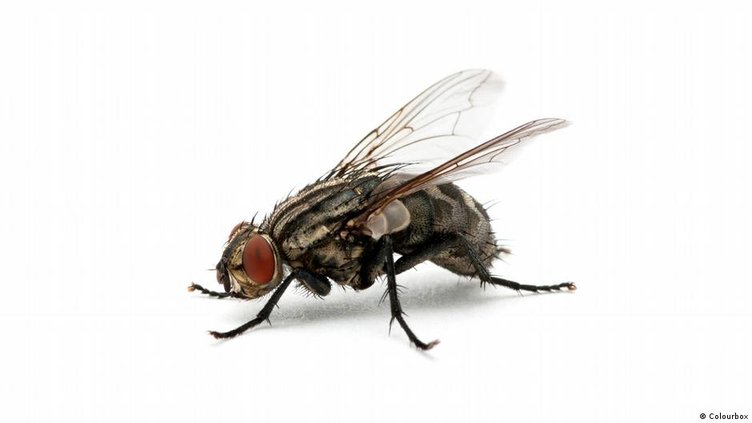
Scientific name: Musca domestica Family: Muscidae Order: Diptera Risk level: Very high Category: Flying pest
? What is the housefly
Scientific name: Musca domestica
Family: Muscidae
Order: Diptera
Risk level: Very high
Category: Flying pest
The housefly (Musca domestica) is one of the world’s most important public-health pests and has accompanied humans since the dawn of civilization. Its gray body is 6–9 mm long, with four longitudinal black stripes on the thorax and large red compound eyes covering most of the head. Its sponging mouthparts allow it to consume only liquid food. It therefore deposits saliva and digestive fluids on solid food before absorbing it, a mechanism that significantly increases its ability to transmit pathogens.
Life cycle of the housefly
The housefly undergoes complete metamorphosis: egg, larva (three instars), pupa and adult. The female lays 5–6 batches of 100–150 eggs at intervals and may produce up to 900 eggs in total. In summer, eggs hatch within 8–24 hours. Maggots pass through three instars in 4–7 days, then pupate for 3–6 days. In hot weather, a generation can be completed in 7–10 days, with up to 12 generations a year in warm regions.
Distribution of the housefly
It is found worldwide. In Saudi Arabia and the Gulf, it is prevalent year-round because of high temperatures and the availability of organic material. Numbers peak in commercial and industrial areas, especially near meat markets, open restaurants and waste-treatment facilities.
Damage and risks associated with the housefly
The housefly is a mechanical carrier of more than 200 documented pathogens, including Salmonella and Shigella bacteria (causes of food poisoning and dysentery), Vibrio cholerae (cholera), Mycobacterium tuberculosis (tuberculosis), hepatitis A and E viruses, helminth eggs and many other pathogens. An individual fly carries, on average, more than one million germs on its external body and in its digestive tract. It can also cause myiasis when its eggs are deposited in open wounds.
Signs of a housefly infestation
Signs include flies gathering on exposed food and preparation surfaces; small black fecal spots on surfaces and walls; white larvae in decomposing organic material and waste containers; and characteristic buzzing. Increased fly counts in insect light traps (ILTs) or sticky traps indicate rising numbers.
Where houseflies are found
Breeding sites include animal manure, accumulated organic waste, food scraps and waste from food-processing plants. Indoor attractants include uncovered waste bins, food residue on work surfaces and unclean drains. Entry points include poorly sealed doors and windows and gaps in walls.
Housefly control methods
Prevention: keep waste containers tightly closed and remove waste regularly, clean drains weekly, and install air curtains at building entrances. Monitoring: use insect light traps (electric insect killers) with counters to track trends. Control: use outdoor ultra-low-volume (ULV) thermal fogging, residual insecticides on resting surfaces, sticky traps and indoor light traps.
Housefly control products
Pyrethroids such as deltamethrin and cypermethrin for residual spraying on resting surfaces; the organophosphate malathion for outdoor ULV fogging; the growth regulator diflubenzuron at breeding sites to prevent emergence; and spinosad as a natural product permitted in sensitive food facilities.
Requirements for controlling houseflies in food facilities
FSSC 22000 Version 7: houseflies are listed as a high risk in PRPs. ILTs must be installed in every food-production area, and monthly insect counts documented. BRCGS: a fly in a production area or product contamination is a Major Non-Conformance. HACCP: houseflies are classified as a biological hazard, and CCPs must be identified.
A fact about the housefly
A housefly regurgitates some of its food onto each clean surface it lands on afterward, a behavior known as regurgitation and defecation that occurs every few seconds. Genomic studies have also found that a fly has genes enabling it to detect and analyze chemicals through 100 types of olfactory receptors on its feet before landing.
Frequently asked questions about the housefly
Q: How can I tell a housefly from a fruit fly?
A: Fruit flies (Drosophila) are much smaller (2–3 mm) and have very large red eyes relative to their size. They gather around ripe fruit, alcoholic drinks and drains. Houseflies are larger (6–9 mm) and gather on many types of organic material.
Q: What is the difference between an ILT and spraying for fly control?
A: An ILT provides monitoring and partial indoor control; it does not replace treatment of outdoor breeding sources. Effective spraying treats breeding sites and outdoor surfaces. The best approach combines both with structural prevention