
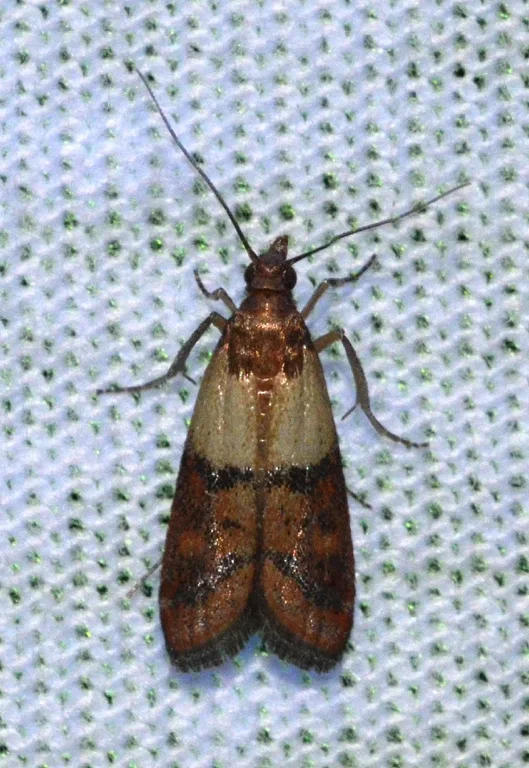
Scientific name: Plodia interpunctella Family: Pyralidae Order: Lepidoptera Risk level: High Category: Flying pest
? What is the Indian meal moth
Scientific name: Plodia interpunctella
Family: Pyralidae
Order: Lepidoptera
Risk level: High
Category: Flying pest
The Indian meal moth (Plodia interpunctella) is one of the most widespread pests in food warehouses worldwide. Its hindwings are gray, while its forewings are two-toned: beige on the front third and reddish brown on the rear two-thirds. The larvae spin silken threads that bind and contaminate food.
Life cycle of the Indian meal moth
It undergoes complete metamorphosis. Eggs are laid directly on food, and the larva is the damaging stage. A full generation takes 4–8 weeks. Multiple generations may breed in an infested warehouse.
Distribution of the Indian meal moth
It occurs in food warehouses worldwide and is common in the Gulf, Saudi Arabia and Egypt, especially in hot warehouses.
Damage and risks associated with the Indian meal moth
It contaminates food with droppings, silken threads and dead insects at different life stages. This can lead to complete product rejection and financial loss.
Signs of an Indian meal moth infestation
Signs include adult moths around light sources; larvae and silken threads in food; droppings and hollow grains caused by weevils and beetles; and small white eggs on food.
Where Indian meal moths are found
They infest dry foods such as nuts, chocolate, legumes, spices, flour, dried fruit and animal feed. Larvae can bore through sealed packaging to enter.
Indian meal moth control methods
Monitor with pheromone traps. Spray the warehouse with pyrethroids. Fumigate stored products with phosphine or methyl bromide. For physical control, lower the temperature below 10°C or raise it above 55°C. Rotate stock using FIFO.
Indian meal moth control products
Pyrethroids for warehouses, phosphine (PH₃) for fumigation, deltamethrin for residual spraying and diatomaceous earth for grain.
Requirements for controlling Indian meal moths in food facilities
FSSC 22000 Version 7: stored-product pests are high priority. Pheromone traps with weekly documentation are mandatory. BRCGS: stored-product pests in a product constitute a major Non-Conformance.
A fact about the Indian meal moth
The Indian meal moth can fly at temperatures between 10 and 35°C. It is mostly active at night, which limits the effectiveness of light traps; sex-pheromone traps provide more accurate monitoring.
Frequently asked questions about the Indian meal moth
Q: How do stored-product pests enter a facility?
A: Usually through incoming shipments. Carefully inspect samples from each shipment and quarantine new purchases.
Q: Is a low temperature enough to eliminate stored-product pests?
A: Yes. Temperatures below 10°C for two weeks stop reproduction and kill vulnerable stages. Temperatures below −18°C for three days kill all stages