
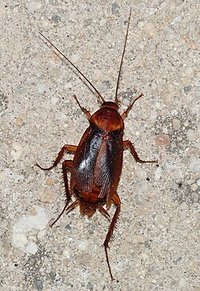
Scientific name: Blatta orientalis Family: Blattidae Order: Blattodea Risk level: High Category: Insect
What is the Oriental cockroach?
Scientific name: Blatta orientalis
Family: Blattidae
Order: Blattodea
Risk level: High
Category: Insect
The Oriental cockroach (Blatta orientalis) is glossy black or very dark brown. It is the slowest-breeding of the main household cockroach species. Females measure 25–28 mm, while males measure 18–29 mm. It prefers cool, damp environments with an optimal temperature of 20–29°C and cannot climb smooth surfaces. It produces a very distinctive unpleasant odor that can help identify an infestation.
Life cycle of the Oriental cockroach
Its life cycle is slower than that of the German cockroach. The ootheca contains 16 eggs, and a female produces 5–8 oothecae. Nymphal development takes 6–12 months and includes 6–7 instars. A generation takes 1–2 years to complete. The species tolerates lower temperatures better than other cockroaches.
Distribution of the Oriental cockroach
It is common in Europe, Asia and North America. In the Gulf region, Egypt and Saudi Arabia, it is concentrated in cooler, wetter places such as old mills, water-treatment facilities, basements and damp warehouses.
Health risks and related problems
The Oriental cockroach is a mechanical carrier of intestinal pathogens such as Salmonella and Escherichia coli. Its association with damp conditions can make it an indicator of moisture-insulation problems in buildings.
Signs of an Oriental cockroach infestation
Signs include a strong, oily, unpleasant odor; dark-brown droppings in cracks and corners; dark-brown oothecae in damp cavities; and sightings in cool, humid areas.
Where Oriental cockroaches are found
They are found in basements, crawl spaces, drainpipes, drainage channels, damp warehouses, beneath broken paving and in dark places with high humidity.
Oriental cockroach control methods
Treat sources of moisture first. Seal gaps and cracks. Apply residual spray in areas where cockroaches congregate. Gel baits can be effective. Improve ventilation to reduce humidity.
Oriental cockroach control products
Deltamethrin or cypermethrin may be used for residual spraying. Place gel baits in areas where cockroaches congregate. Insect growth regulators (IGRs) may also be used.
Requirements for controlling Oriental cockroaches in food facilities
FSSC/BRCGS: the Oriental cockroach is included in pest-control plans alongside other cockroach species as a high-risk pest in food facilities.
A fact about the Oriental cockroach
The Oriental cockroach can survive for a full month without water—one of the longest periods of drought tolerance among cockroaches, despite its preference for damp conditions.
Frequently asked questions about the Oriental cockroach
Q: Can the Oriental cockroach climb walls?
A: It cannot climb smooth surfaces such as mirrors, glass or smooth plastic. This distinguishes it from the German cockroach.
Q: Why does it smell stronger than the German cockroach?
A: It produces more defensive chemicals (quinones) in its secretions and droppings. This odor can be used to detect an infestation early