
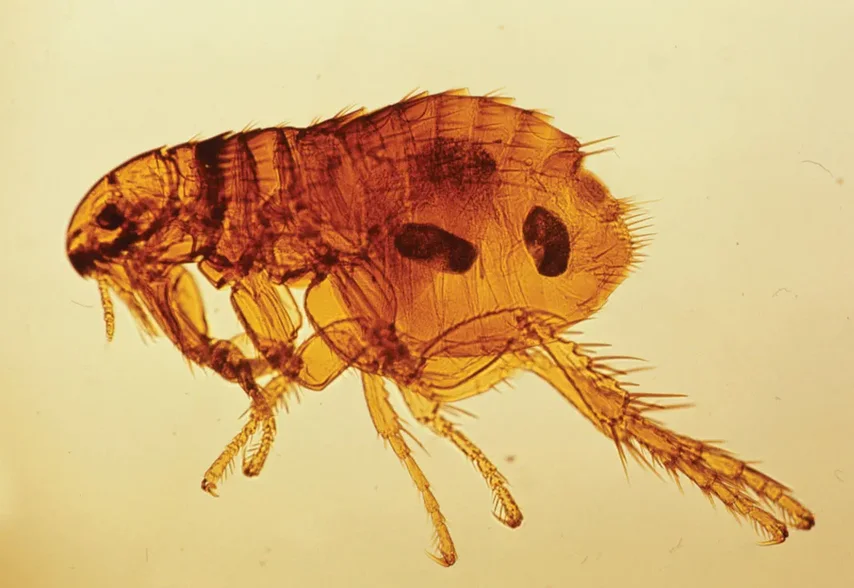
Scientific name: Xenopsylla cheopis Family: Pulicidae Order: Siphonaptera Risk level: Very high Category: Insect
? What is the Oriental rat flea
Scientific name: Xenopsylla cheopis
Family: Pulicidae
Order: Siphonaptera
Risk level: Very high
Category: Insect
The Oriental rat flea (Xenopsylla cheopis) is one of the most dangerous parasites in human history. It is the primary vector of the bubonic plague bacterium Yersinia pestis and the cause of murine typhus, Rickettsia typhi. It served as a biological bridge between rodents and people during major historical epidemics. It measures 2–2.5 mm and is translucent brown; unlike the cat flea, it lacks the characteristic spiny combs.
Life cycle of the Oriental rat flea
Its life cycle is similar to that of the cat flea. It is associated exclusively with rodent environments. A female lays 300–400 eggs.
Distribution of the Oriental rat flea
It is found worldwide in tropical and subtropical regions. In Saudi Arabia, the Gulf and Egypt, it is associated with black and Norway rats in ports and warehouses.
Damage and risks associated with the Oriental rat flea
It can transmit bubonic plague (Yersinia pestis), for which scattered cases are still documented worldwide; murine typhus (Rickettsia typhi), which causes a mild fever and rash; and Bartonella bacilliformis in some regions.
Signs of an Oriental rat flea infestation
Signs include bites in rodent environments and fleas occurring alongside rat colonies in warehouses and ports. Xenopsylla may be detected when dead rodents are examined.
Where Oriental rat fleas are found
They occur only in rodent environments: on rats, in rodent nests and burrows, and in places close to rodent colonies.
Oriental rat flea control methods
Control rodents first and comprehensively. After confirming that rodents have been eliminated, apply insecticide in their nesting areas. The order matters: remove the rodents first, then treat the fleas; otherwise, fleas may attack people.
Oriental rat flea control products
Use pyrethroids to spray rodent nesting areas and IGRs to prevent larval development. Rodents must not be removed without immediately treating the fleas.
Requirements for controlling Oriental rat fleas in food facilities
FSSC/BRCGS: Xenopsylla is detected through rodent-monitoring programs. Its presence indicates an active rodent colony and constitutes a major Non-Conformance.
A fact about the Oriental rat flea
The Black Death, which killed one-third of Europe’s population in the 14th century, spread mainly through Xenopsylla cheopis on black rats aboard commercial ships. The relationship between a single flea and a rat changed the course of human civilization.
Frequently asked questions about the Oriental rat flea
Q: Is there still a risk of plague from this flea?
A: The risk is low under modern conditions with antibiotic treatment, but plague has not been completely eradicated. Sporadic cases are still recorded in Africa, Asia and the Americas. Good rodent control is the first line of protection.
Q: How can I distinguish the rat flea from the cat flea?
A: Identification requires microscopic examination: Xenopsylla lacks the ctenidia (spiny combs) that distinguish the cat flea. Send samples to a specialist laboratory for confirmation