
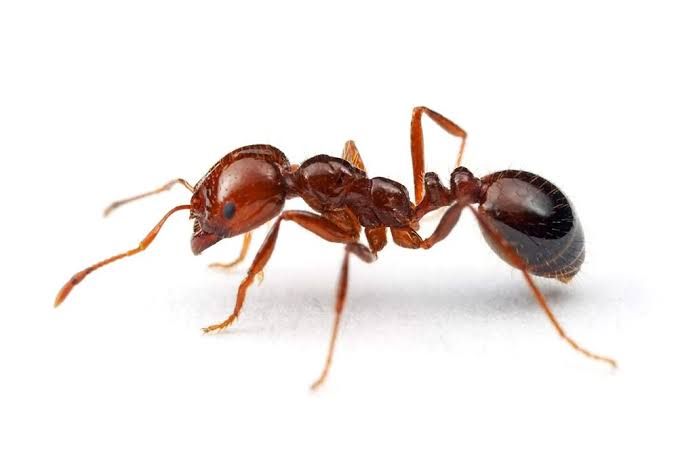
Scientific name: Solenopsis invicta Family: Formicidae Order: Hymenoptera Risk level: Very high Category: Insect
? What is the red imported fire ant
Scientific name: Solenopsis invicta
Family: Formicidae
Order: Hymenoptera
Risk level: Very high
Category: Insect
The red imported fire ant (Solenopsis invicta) is one of the world’s most dangerous invasive insects from both health and economic perspectives. It is highly aggressive and has a rapid, coordinated defensive response: hundreds may attack at once and sting repeatedly. Its sting injects solenopsin and causes intense burning pain and skin blisters. In people with severe allergies, it can cause anaphylactic shock that may be fatal in less than a minute.
Life cycle of the red imported fire ant
Colonies are large, with 100,000–500,000 individuals. The queen lays 1,500 eggs a day. The distinctive soil mound may reach 60 cm in height. Alates are produced in spring.
Distribution of the red imported fire ant
Native to South America, it has invaded North America and parts of Asia and Australia. In the Gulf and Saudi Arabia, the risk is especially associated with agricultural shipments.
Damage and risks associated with the red imported fire ant
Multiple stings cause immediate burning pain and white blisters within 24 hours. Sensitive people may develop anaphylaxis. The ant also damages crops and small animals and can affect electrical equipment and communications systems.
Signs of a red imported fire ant infestation
Signs include a distinctive soil mound with no obvious central opening; very aggressive red ants measuring 2.4–6 mm when disturbed; and white skin blisters after a sting.
Where red imported fire ants are found
They build soil mounds in open areas such as gardens, playgrounds, outdoor factory floors, workers’ rest areas, roadsides and walkways.
Red imported fire ant control methods
Treat mounds directly with liquid or granular pesticides. Use individual mound treatment and perimeter gel baits to prevent expansion. Evacuate the infested area immediately.
Red imported fire ant control products
Hydramethylnon granules for broadcast perimeter treatment, spinosad for environmentally safe treatment, and pyrethroids for direct mound treatment.
Requirements for controlling red imported fire ants in food facilities
FSSC/BRCGS: fire ants in gardens surrounding a facility are a risk to workers. Mound locations and the immediate treatment protocol must be documented.
A fact about the red imported fire ant
Fire ants have an unusual collective decision-making process: groups of workers signal their choice of a new colony site through movement, in a process similar to scout bees voting on a location for a new hive.
Frequently asked questions about the red imported fire ant
Q: What should I do if I am stung by a fire ant?
A: Move away from the attack immediately. Wash the area with soap and water. Do not burst the blisters. If you have difficulty breathing or feel dizzy, these may be signs of anaphylaxis—call emergency services immediately. Anyone with an EpiPen should use it.
Q: Are fire ants found in Saudi Arabia and the Gulf?
A: Reports are limited so far, but agricultural imports remain a possible route of entry. Ongoing inspection at agricultural entry points is necessary to limit their arrival