
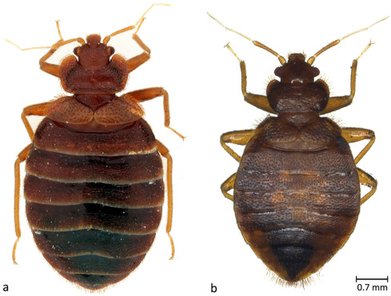
Scientific name: Cimex hemipterus Family: Cimicidae Order: Hemiptera Risk level: High Category: Insect
? What is the tropical bed bug
Scientific name: Cimex hemipterus
Family: Cimicidae
Order: Hemiptera
Risk level: High
Category: Insect
The tropical bed bug (Cimex hemipterus) is a close relative of the common bed bug (Cimex lectularius), but is better adapted to tropical and subtropical climates. It is more common in Africa, Southeast Asia and parts of the Middle East. Distinguishing it from the common bed bug requires microscopic examination, but its behavior and control are almost identical.
Life cycle of the tropical bed bug
Its life cycle is very similar to that of the common bed bug. It prefers slightly higher temperatures (28–35°C).
Distribution of the tropical bed bug
It is common in tropical Africa and Southeast Asia. Its presence is increasing in the Gulf through travel from tropical regions.
Damage and risks associated with the tropical bed bug
As with the common bed bug, it causes nighttime bites, allergic reactions, sleep disruption and reputational damage for hotels.
Signs of a tropical bed bug infestation
The signs are the same as for the common bed bug: blood spots, dark droppings, shed skins and oothecae.
Where tropical bed bugs are found
As with the common bed bug, they are found along mattress edges and bed frames and behind pictures.
Tropical bed bug control methods
As with the common bed bug, use specialized heat or chemical treatment.
Tropical bed bug control products
Fipronil, imidacloprid and novaluron, with rotation of active ingredients.
Requirements for controlling tropical bed bugs in food facilities
FSSC/BRCGS: treat the tropical bed bug in the same way as the common bed bug under hotel quality protocols.
A fact about the tropical bed bug
Genomic studies indicate that C. hemipterus may naturally have higher resistance to some pesticides than C. lectularius. Accurate species identification is therefore important when selecting the most suitable control protocol.
Frequently asked questions about the tropical bed bug
Q: How can I distinguish the tropical bed bug from the common bed bug?
A: In practice, they cannot be distinguished with the naked eye; specialist microscopic examination is required. From a management perspective, the control approach is the same for both species.
Q: Is it harder to control than the common bed bug?
A: Some studies indicate higher pesticide resistance, so heat treatment is preferred in tropical environments