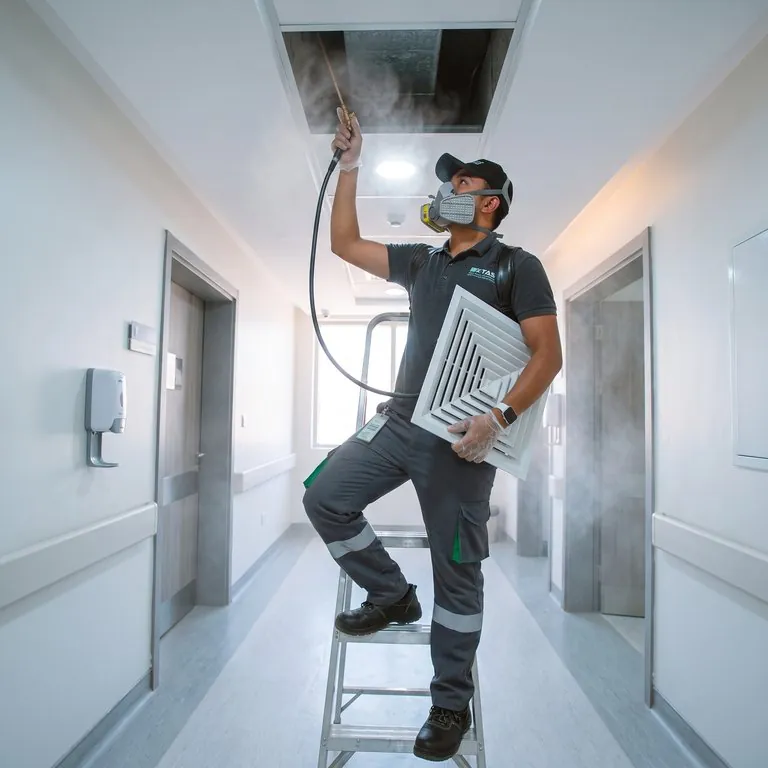
When You Need Pigeon Control
- Droppings accumulating on outdoor air-conditioning units and windows.
- Nests and feathers between units or in extractor openings.
- Persistent cooing and wing sounds early in the morning.
- Facade stains and deteriorating paint beneath ledges.
- Unpleasant odors near rooftop tanks or roof rooms.
- For bats: Small dark droppings beneath a roof opening or behind panels, with activity at sunset.
Why Pigeons Are Common in the Hejaz Cities
- Madinah and Makkah have large pigeon populations around squares and markets, where visitors regularly feed them.
- Tall buildings and hotels offer shaded ledges and projections suitable for nesting.
- Outdoor air-conditioning units provide shade and condensation water during hot summers.
- Open roofs and tanks in residential neighborhoods provide quiet nesting locations.
- Bats settle in voids between suspended ceilings and walls in older buildings and near farms, particularly in AlUla and Taif.
Damage Caused by Pigeon Droppings
Air-Conditioning Units
Droppings, feathers, and nests accumulate on condensers, obstruct airflow, and raise unit temperatures. This increases electricity use and summer breakdowns.
Facades
Droppings are acidic and leave stubborn stains on stone, marble, and paint. Over time, they spoil the building's appearance, particularly important for hotels and commercial properties.
Tanks and Roofs
Droppings and feathers near rooftop tank openings can contaminate water if covers are not tightly closed. Nests also block roof drains, causing rainwater to collect in Jeddah.
Diseases Associated with Droppings — General Information
Accumulated bird droppings are associated with diseases such as cryptococcosis and histoplasmosis, fungal infections that may be acquired by inhaling dust from dried droppings. According to CDC, the risk is higher when cleaning large accumulations without protection and for people with weakened immunity. Do not sweep dry droppings yourself or use compressed air. Nests also attract pests such as bird mites.
Comparing Pigeon Deterrents
| Solution | How It Works | Suitable For | Approximate Lifespan | Notes |
| Netting | Closes off the entire space so pigeons cannot enter | Balconies, gaps between air-conditioning units, and internal courtyards | 5–10 years | Most effective for enclosed spaces; color is chosen to match the facade |
| Spikes | Prevent perching on ledges without injury | Ledges, air-conditioning unit tops, and signs | 5 years or more | Polycarbonate or stainless steel; does not injure birds |
| Tensioned wires | A thin wire makes perching unstable | Fences and long roof edges | Several years | Almost invisible; suitable for premium facades |
| Repellent gel | A sticky surface uncomfortable for birds' feet | Narrow architectural ledges | Months to a year | Affected by dust and heat; requires renewal |
| Repellent devices | Sound, light, or moving visual elements | Open spaces such as parking areas and warehouses | Depends on the device | Birds become accustomed over time; used as a supplement |
We choose the solution after inspection, often combining two methods: netting for open spaces and spikes for ledges.
Our Process Step by Step
- Inspection: Identifying perching and nesting areas, bird numbers, and facade type, and photographing conditions.
- Nest removal: We remove empty nests. If eggs or chicks are present, we follow [Company-approved procedure for handling them] before closing the area.
- Cleaning and disinfection: We dampen droppings before removal to prevent dust, wear suitable respiratory protection, and disinfect the surface.
- Installation: We secure netting, spikes, or wires with fittings that avoid facade damage where possible.
- Follow-up: We assess results and address any spot pigeons return to.
Treatment by Area
| Area | Method | Product / Tool Type | When It Is Safe |
| Outdoor air-conditioning units | Spikes on top and netting behind the unit | Polycarbonate spikes and polyethylene netting | As soon as installation is complete |
| Balconies | Full enclosure with netting | Sun-resistant netting in a suitable color | Immediately |
| Facade ledges and windows | Spikes or tensioned wires | Stainless steel spikes or [Wire type] wires | Immediately |
| Roofs and tanks | Nest removal and cleaning, then closing gaps | Surface disinfectant and netting | After the disinfectant dries, 1–2 hours |
| Bat entry openings | One-way exits, followed by sealing | One-way exclusion device and sealing with building materials or metal mesh | Immediately; final sealing after confirming the bats have left |
Bats: Exclusion and Sealing Entry Points
Bats feed on insects, and killing them is not an appropriate solution. Killing them inside ceilings also causes odors and insect problems. Our approach is:
- Identify entry openings by observing at sunset.
- Install a one-way exit device that lets bats leave at night and prevents their return.
- Seal openings permanently after confirming they have left.
- Remove accumulated droppings using respiratory protection and disinfect the area.
Do not handle a bat with bare hands. If contact or a bite occurs, seek medical advice.
Animal Welfare
We do not use poisons, adhesives that trap birds, or sharp spikes that injure them. Our goal is to prevent access. We install barriers without trapping birds inside the netting and inspect the area before closing it.
Pigeon Control Prices
| Work Type | Approximate Price Range |
| One air-conditioning unit (spikes and cleaning) | 230 –300 SAR |
| Balcony netting | Priced per square meter |
| Full facade or roof | Quoted after inspection |
| Bat exclusion and entry-point sealing | 300–900 SAR |
Use the Price Calculator for an estimate or request a free inspection.
Before and After the Service
Before the service: Clear the balcony and provide safe roof access. Tell us if a lift is needed to reach the facade.
After the service: Do not feed pigeons near the building. Clean ledges regularly and report any holes in the netting. If disinfectant is used, wait until it dries. General guidance is on the instructions before and after pest control page.
Guarantee
Installation is guaranteed for 30 days. If pigeons find an opening in the treated area, we return and fix it at no charge. The materials themselves have a [Materials guarantee period]. See the Guarantee page.
Prevention Tips
- Do not leave food or grain on balconies or roofs.
- Fit tightly closed covers over rooftop tank openings.
- Remove nests when they first appear, before eggs are laid.
- Fit mesh covers over extractor openings.
When are these measures insufficient? Household deterrents such as reflective strips and decoys work only for days before pigeons become accustomed to them. Physical exclusion is the lasting solution. Learn about pigeons in our Pest Library.
Frequently Asked Questions
Q: Do spikes hurt pigeons?
No. Their tips are not sharp; they only prevent perching.
Q: Does netting block the view or airflow?
The netting is thin, with openings wide enough for air and light. We choose a color close to the facade.
Q: Are sound devices enough?
They help in open spaces, but birds become accustomed over time, so we use them as a supplement.
Q: Do you remove accumulated droppings?
Yes. Dampening, removal, and surface disinfection are included in the service.
Q: Do you kill bats?
No. We exclude them with a one-way exit device, then seal openings.
Q: Do you serve hotels and warehouses?
Yes. We offer scheduled follow-up programs for hotels and warehouses.
Areas We Serve
We serve Madinah from Al-Aridh (0546267778), Makkah from Al-Lith Road (0543545708), and Jeddah from Al-Mushrifah (0543627774), as well as Yanbu, Taif, and AlUla.