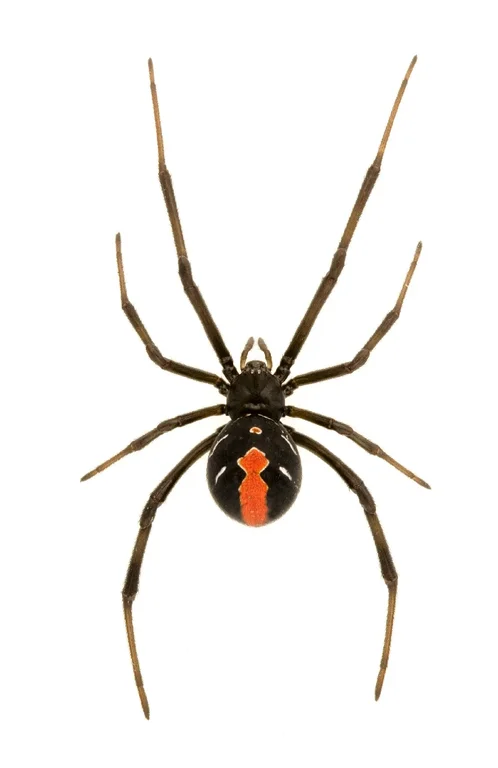
Scientific name: Latrodectus mactans Family: Theridiidae Order: Araneae Risk level: Very high Category: Crawling pests
? What is a black widow
The black widow (Latrodectus mactans) is one of the best-known venomous spiders in the world. The female (8–15 mm) is glossy black, with a red hourglass-shaped mark on the abdomen. Its venom (alpha-latrotoxin) is a potent neurotoxin that causes severe muscle pain, cramps and systemic symptoms.
Black widow life cycle
Its life cycle progresses from egg to spiderling to adult. Depending on the species, an adult spider may live 1–3 years. Females are larger than males in most venomous species.
Where black widows occur
They occur in many regions. Dangerous species are found in the Gulf, Saudi Arabia, Egypt and North Africa.
Damage and risks associated with black widows
The neurotoxin causes latrodectism: progressively worsening severe muscle pain within 30–60 minutes, cramps, sweating, nausea and high blood pressure. Death is rare with treatment.
Signs of black widows
Look for webs in corners and cracks, white egg sacs, or adult spiders in the dark or when moving furniture.
Where black widows are found
They occur in outdoor storage areas, stacked firewood, old tires, outdoor toilets and along warehouse wall bases. They build irregular, tangled webs close to the ground.
Black widow control methods
Conduct careful visual inspections, use UV light to detect webs, place sticky traps, clean thoroughly and seal cracks.
Black widow control products
Apply pyrethroids where spiders are present. Use diatomaceous earth dust in cracks. Seal gaps and cracks.
Food-facility control requirements
FSSC/BRCGS: venomous spiders are an occupational safety risk. The control program must be documented.
A fact about black widows
The name comes from the female sometimes eating the male after mating. This behavior is rare in nature and has occurred in laboratories under abnormal conditions. Recent research indicates that the male usually survives.
Frequently asked questions
Q: Are black widows dangerous?
A: Their risk level is very high. Their neurotoxic venom can cause progressively worsening severe muscle pain within 30–60 minutes, cramps, sweating, nausea and high blood pressure. Avoid approaching one and contact a specialist immediately.
Q: What should I do after a spider bite?
A: Go to the emergency department immediately in cases involving venomous species. Keep the spider for identification if possible. Do not press on the bite