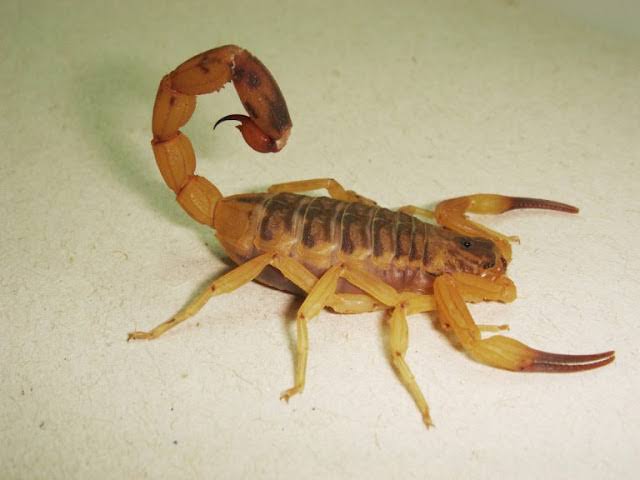
Scientific name: Tityus serrulatus Family: Buthidae Order: Scorpiones Risk level: Very high Category: Crawling pests
? What is a Brazilian scorpion
The Brazilian yellow scorpion (Tityus serrulatus) is ranked as the most dangerous in the Western Hemisphere and is responsible for 90% of scorpion-related deaths in Brazil (more than 100 deaths annually). It reproduces parthenogenetically, without males, enabling it to invade new environments from a single individual.
Brazilian scorpion life cycle
It has a long life cycle: it gives birth to live young, which remain on the mother’s back for 7–14 days, then undergo 4–7 molts to reach maturity over 2–6 years. Adults live 5–25 years.
Where Brazilian scorpions occur
They are found in dry and desert regions. Multiple dangerous species occur in Saudi Arabia, the Gulf, the Arabian Peninsula, Egypt and the MENA region.
Damage and risks associated with Brazilian scorpions
Its highly dangerous venom causes excessive secretion from various glands: saliva, tears, gastric secretions and heavy sweating, as well as burning pain and cardiac disturbances. Pulmonary edema may occur in severe cases.
Signs of Brazilian scorpions
Look for the scorpion itself or signs of activity (shed skins) beneath stones and firewood. UV light can be used at night for immediate detection.
Where Brazilian scorpions are found
They occur in Brazilian cities, wall cracks, behind firewood and furniture, and in tropical-fruit warehouses. They may be transported to other countries in banana boxes.
Brazilian scorpion control methods
Completely seal cracks and openings in walls and doors. Install protective screens. Apply perimeter pyrethroid treatment. In infested areas, inspect shoes and clothing daily.
Brazilian scorpion control products
Use long-lasting pyrethroids (bifenthrin, deltamethrin) around the perimeter. Treat walls and floors in infested areas.
Food-facility control requirements
FSSC/BRCGS: scorpions in Gulf-region facilities are a serious occupational risk. A clear monitoring protocol and worker training are mandatory.
A fact about Brazilian scorpions
Tityus serrulatus is biologically exceptional: it reproduces exclusively by parthenogenesis, meaning that nearly all individuals in most colonies are genetically identical females, a very rare trait among scorpions.
Frequently asked questions
Q: What should I do after a scorpion sting?
A: Go to the nearest emergency department immediately, regardless of the initial pain level, because the venom acts gradually. Keep a photo of the scorpion if possible. Do not apply cold to the sting.
Q: How can I detect scorpions at home at night?
A: Use a UV (ultraviolet) flashlight. Scorpions glow bright green under UV light, making them easy to spot in the dark