Scientific name: Rattus norvegicus Family: Muridae Order: Rodentia Risk level: Very high Category: Crawling pests
? What is a Norway rat
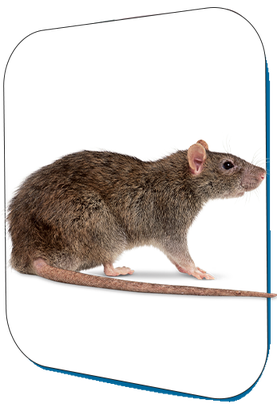
The Norway rat (Rattus norvegicus), also known as the brown rat or sewer rat, is the largest and most common urban rat and one of the world's most dangerous pests to public health and the economy. Its body is 20–26 cm long, excluding the tail; in this species the tail is shorter than the body, unlike in the black rat. It is grayish-brown above and lighter underneath. It nests and burrows at ground level and is commonly found in basements, lower floors and sewers.
Norway rat life cycle
Norway rats live 2–3 years in the wild. Females reach sexual maturity three months after birth. Gestation lasts 21–23 days, with 6–14 pups per litter. A female can have 4–7 litters annually, averaging 40–60 pups a year. The pups open their eyes after 14 days and are weaned after three weeks. Under ideal conditions, one female could theoretically produce a colony of more than 2,000 rats in one year.
Where Norway rats occur
They are found on every continent except Antarctica. In Saudi Arabia and the Gulf, they are concentrated in industrial areas, ports, warehouses, old commercial districts and near sewage networks. They may act as carriers of disease and rat plague at seaports.
Damage and risks associated with Norway rats
Norway rats carry more than 35 documented human diseases, including leptospirosis, transmitted through urine; hemorrhagic fever with renal syndrome (HFRS) caused by hantaviruses; salmonellosis; plague (historically via fleas); trichinellosis; and typhoid. They cause major economic damage by gnawing electrical wires (a major cause of fires), damaging food products and contaminating food with droppings.
Signs of Norway rats
Key signs include large droppings with pointed ends (20–25 mm), clear gnaw marks on walls, wires and packaging, footprints in dusty areas, greasy smear marks on walls at ground level, and nighttime digging or running sounds. Urea in rat urine glows under UV light, aiding detection.
Where Norway rats are found
They nest in soil beneath buildings, floors and gardens. Indoors, they occur under storage pallets, behind heavy appliances and along lower walls. Outdoors, they occur in waste piles, dense grass and around garbage containers.
Norway rat control methods
Prevention is essential: seal all openings wider than 6 mm with steel or concrete, raise stock at least 30 cm off the floor, and remove firewood and scrap. Monitor using numbered tamper-resistant bait stations, tracking dust and sticky traps. Control measures include first- and second-generation anticoagulant baits, mechanical traps and immediate action when activity is detected.
Norway rat control products
First-generation anticoagulants include warfarin and chlorophacinone, used in professional stations. Second-generation products include brodifacoum, bromadiolone and difethialone; they are more effective and used where resistance to first-generation products occurs. Second-generation baits must be used only in secure stations to avoid harming non-target animals.
Food-facility control requirements
FSSC 22000 V7: rodent activity (droppings, tracks or hair) in any area is a major non-conformance that stops the production line. Monitoring-station maps must be updated whenever changes occur. BRCGS requires tamper-resistant, numbered stations inspected according to a documented schedule.
A fact about Norway rats
Rats have remarkable learning ability and social memory. They learn from one another to avoid new baits (neophobia), especially after one rat becomes ill from a particular bait. This behavior complicates control and helps explain why poorly planned poison-baiting efforts often fail.
Frequently asked questions
Q: How can I tell a Norway rat from a black rat?
A: The Norway rat is larger and heavier, has a tail shorter than its body, and lives at ground level and in basements. The black rat is smaller and slender, has a tail longer than its body, climbs, and lives in roofs and trees.
Q: Is one bait enough to eliminate a rat colony?
A: No. Effective rodent control relies on multiple bait stations, removing food, water and entry points, and monitoring for weeks after the first intervention.