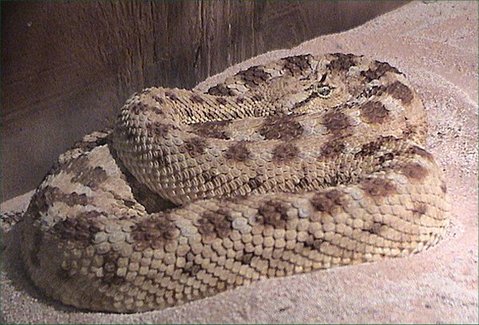
Scientific name: Cerastes cerastes Family: Viperidae Order: Squamata Risk level: Very high Category: Reptiles
What is a horned viper?
The horned viper (Cerastes cerastes) is distinguished by two small horns above its eyes, its most notable identifying feature. It measures 30–85 cm. It hides in sand using a remarkable sideways-burrowing technique that leaves it almost completely concealed. It is active at night, especially at dawn.
Horned viper life cycle
Reptiles may lay eggs or, in some cases, give birth to live young. Their life cycle depends on environmental temperature. Snakes reproduce once or twice a year.
Where horned vipers occur
Reptiles are common in dry and desert regions of Saudi Arabia, the Gulf and the MENA region.
Damage and risks associated with horned vipers
Its venom is a mixture of cytotoxins and hemotoxins. It causes severe pain and immediate swelling, local necrosis, clotting disorders and, in severe cases, kidney failure.
Signs of horned vipers
Signs include direct sightings, shed skins, tracks in sand and eggs in warm soil.
Where horned vipers are found
They occur in desert sands and around the edges of date-palm farms in the Arabian Peninsula. They hide in sand accumulations near stones and plants.
Horned viper control methods
Completely seal openings. Remove firewood and piled materials. Notify specialists immediately. Do not touch snakes.
Horned viper control products
Chemical pesticides are not usually used for reptiles. Sticky traps are used for lizards. Remove habitats and seal cracks.
Food-facility control requirements
FSSC/BRCGS: venomous snakes pose an extremely serious occupational risk and require an immediate evacuation protocol and notification of a specialist.
A fact about horned vipers
The horned viper moves by “sidewinding,” advancing parts of its body sideways rather than straight ahead. This reduces contact with hot sand and improves movement on unstable sandy ground.
Frequently asked questions
Q: What should I do if I see a snake in a facility?
A: Evacuate the area immediately. Do not approach or try to catch it. Notify a specialist or the relevant authorities. Photograph it from a safe distance for identification.
Q: How can I prevent snakes from entering a building?
A: Seal all openings larger than 6 mm in walls and ceilings. Remove firewood, stones and anything that provides shelter. Bright lighting around the exterior acts as a natural deterrent.