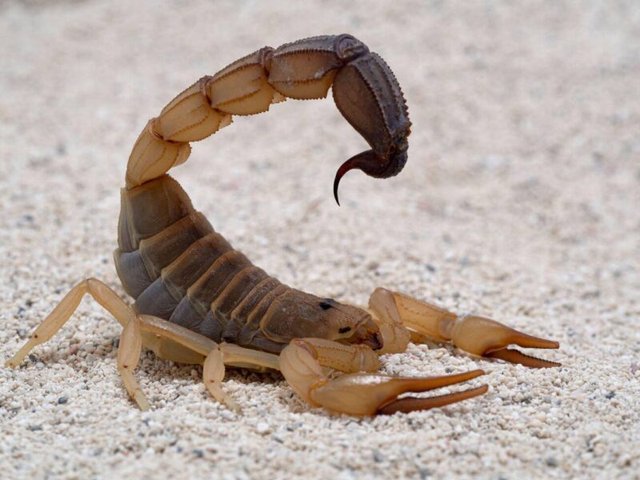
Scientific name: Androctonus crassicauda Family: Buthidae Order: Scorpiones Risk level: Very high Category: Crawling pests
? What is the Gulf thick-tailed scorpion
The Arabian thick-tailed scorpion (Androctonus crassicauda) is one of the most dangerous scorpions in the Arab region and is common in Saudi Arabia, Kuwait, Jordan and Syria. It is dark brown with a very thick tail, which gives it its name, and measures 8–10 cm.
Gulf thick-tailed scorpion life cycle
It has a long life cycle: it gives birth to live young, which remain on the mother’s back for 7–14 days, then undergo 4–7 molts to reach maturity over 2–6 years. Adults live 5–25 years.
Where Gulf thick-tailed scorpions occur
They are found in dry and desert regions. Multiple dangerous species occur in Saudi Arabia, the Gulf, the Arabian Peninsula, Egypt and the MENA region.
Damage and risks associated with Gulf thick-tailed scorpions
Its venom is comparable in potency to that of Leiurus. It causes severe pain, cramps and cardiorespiratory disturbances. It is responsible for most fatal scorpion stings in the Arabian Peninsula.
Signs of Gulf thick-tailed scorpions
Look for the scorpion itself or signs of activity (shed skins) beneath stones and firewood. UV light can be used at night for immediate detection.
Where Gulf thick-tailed scorpions are found
They occur across the Arabian Peninsula, Sinai, Jordan and the Levant, in rocky or sandy soil, under stones, and in cracks and along the edges of rural buildings.
Gulf thick-tailed scorpion control methods
Completely seal cracks and openings in walls and doors. Install protective screens. Apply perimeter pyrethroid treatment. In infested areas, inspect shoes and clothing daily.
Gulf thick-tailed scorpion control products
Use long-lasting pyrethroids (bifenthrin, deltamethrin) around the perimeter. Treat walls and floors in infested areas.
Food-facility control requirements
FSSC/BRCGS: scorpions in Gulf-region facilities are a serious occupational risk. A clear monitoring protocol and worker training are mandatory.
A fact about Gulf thick-tailed scorpions
Androctonus means “man-killer” in Arabic, a name reflecting the historical scientific assessment of its extreme danger since ancient times in the Middle East.
Frequently asked questions
Q: What should I do after a scorpion sting?
A: Go to the nearest emergency department immediately, regardless of the initial pain level, because the venom acts gradually. Keep a photo of the scorpion if possible. Do not apply cold to the sting.
Q: How can I detect scorpions at home at night?
A: Use a UV (ultraviolet) flashlight. Scorpions glow bright green under UV light, making them easy to spot in the dark