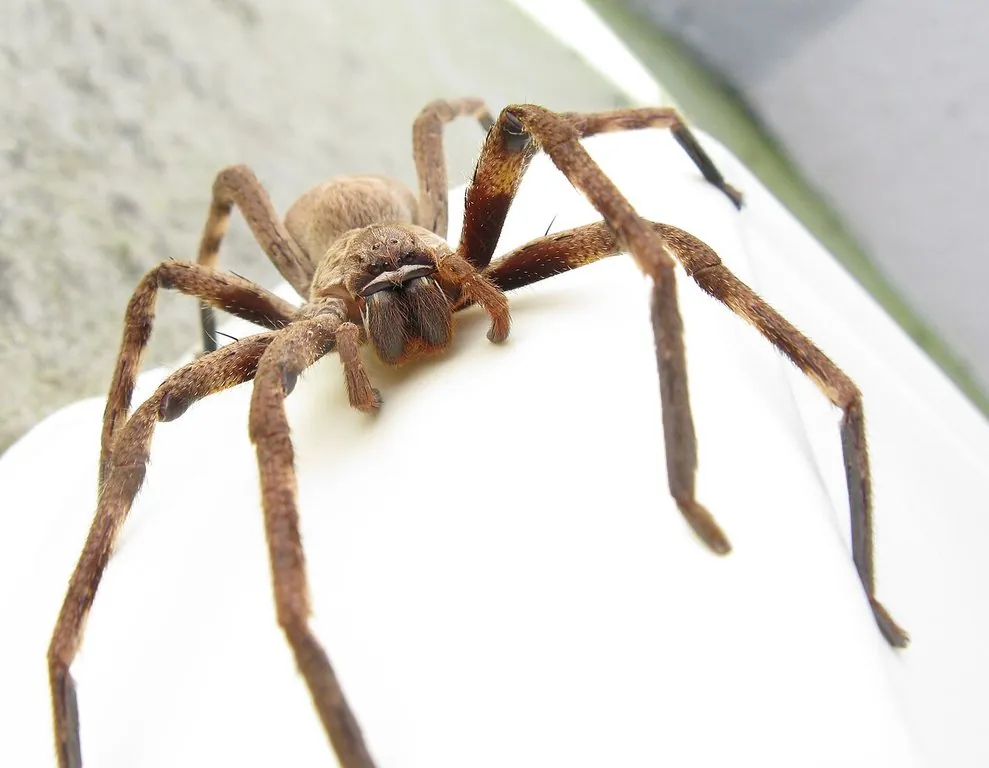
Scientific name: Heteropoda venatoria Family: Sparassidae Order: Araneae Risk level: Low Category: Crawling pests
? What is a huntsman spider
The huntsman spider (Heteropoda venatoria) is one of the largest household spiders. The female reaches 25 mm, with a leg span of up to 12 cm. Despite its frightening appearance, its venom is weak and its bite rarely causes more than localized swelling. It is considered beneficial because it hunts cockroaches and other insects.
Huntsman spider life cycle
Its life cycle progresses from egg to spiderling to adult. Depending on the species, an adult spider may live 1–3 years. Females are larger than males in most venomous species.
Where huntsman spiders occur
They occur in many regions. Dangerous species are found in the Gulf, Saudi Arabia, Egypt and North Africa.
Damage and risks associated with huntsman spiders
Its bite causes only temporary localized pain and swelling. It does not transmit diseases. It is ecologically beneficial.
Signs of huntsman spiders
Look for webs in corners and cracks, white egg sacs, or adult spiders in the dark or when moving furniture.
Where huntsman spiders are found
They occur in tropical and subtropical homes, timber stores, shipping containers, and behind pictures and furniture. They spread via ships and imported goods.
Huntsman spider control methods
Conduct careful visual inspections, use UV light to detect webs, place sticky traps, clean thoroughly and seal cracks.
Huntsman spider control products
Apply pyrethroids where spiders are present. Use diatomaceous earth dust in cracks. Seal gaps and cracks.
Food-facility control requirements
FSSC/BRCGS: venomous spiders are an occupational safety risk. The control program must be documented.
A fact about huntsman spiders
Huntsman spiders hunt by speed rather than by web: they track their prey and leap on it with great accuracy, which gives them their name. They can detect vibrations through sensors in their eight legs from several meters away.
Frequently asked questions
Q: Are huntsman spiders dangerous?
A: Their risk level is low. Their bite causes only temporary localized pain and swelling. They do not transmit diseases and are ecologically beneficial.
Q: What should I do after a spider bite?
A: Go to the emergency department immediately in cases involving venomous species. Keep the spider for identification if possible. Do not press on the bite